
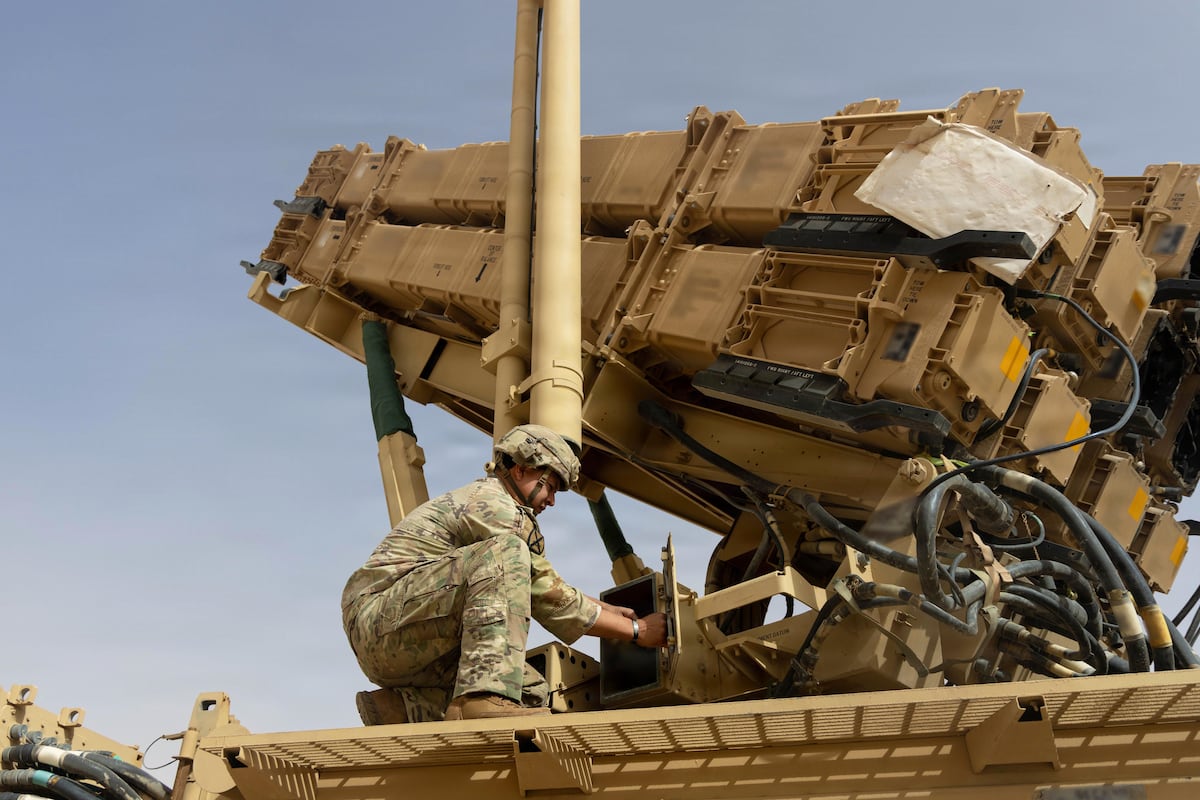

The Army is creating a new military occupational specialty dedicated to operating and maintaining Patriot and Terminal High Altitude Area Defense (THAAD) missile systems.
The new career field, designated Air and Missile Defense Systems Repairer, or 14W, will combine two existing specialties responsible for Patriot operations and maintenance, according to Army officials.
Army spokesman Maj. Travis Shaw told the Association of the United States Army that the service will create the 14W specialty by merging military occupational specialties 14E and 14T.
The Army is actively recruiting personnel and seeking volunteers in grades E-3 through E-7 from both specialties for the new role. The service hopes to recruit approximately 300 soldiers before the new MOS officially launches on Oct. 1.
The Army detailed the new specialty in an April 1 military personnel message, according to Task & Purpose. The move comes amid growing demand for missile and drone defense capabilities around the world.
According to a Congressional Research Service report, THAAD batteries are stationed in Guam and South Korea and have seen regular deployments to the Middle East, where they help defend Israel and support U.S. military operations in Iran.
The new MOS also reflects the Army’s expanding role in operating THAAD, the CRS report added. While the Missile Defense Agency traditionally managed the system, the Army has increasingly assumed responsibility for THAAD operations as part of a broader effort to streamline air and missile defense missions under a single service.
The Army is expected to take full control of THAAD units by the end of fiscal year 2027.
Combining THAAD and Patriot capabilities is not a new concept as they have overlapping mission sets, according to the most recent factsheet published by the Arms Control Association.
The THAAD system is meant to counter threats “at the end of their midcourse stage and in the terminal stage,” whereas the Patriot system is meant “to defend against short- and medium-range ballistic missiles in their terminal stage at lower altitudes than the THAAD system.”
In a 2024 article published by the Army’s Line of Departure journal, Capt. Michael J. McTiernan argued that integrating the two systems embraces the Army’s “any sensor, best shooter” doctrine.
McTiernan wrote that the consolidation would create additional engagement opportunities, expand the defended battlespace and leverage the unique strengths of both Patriot and THAAD systems.
Col. Angela Chipman, chief of the Army Retention Division at the Pentagon, built on that concept, telling the AUSA that the “transformational move helps the Army develop the type of agile talent it needs for current and future battlefields.”
Daniel Terrill is a contributor to Military Times. He’s been reporting on military issues, the gun industry, and the outdoors for nearly two decades. Although writing is his passion, he’s been a Marine, police officer, and, perhaps the most dangerous job of his career, a substitute teacher.
Read the full article here