

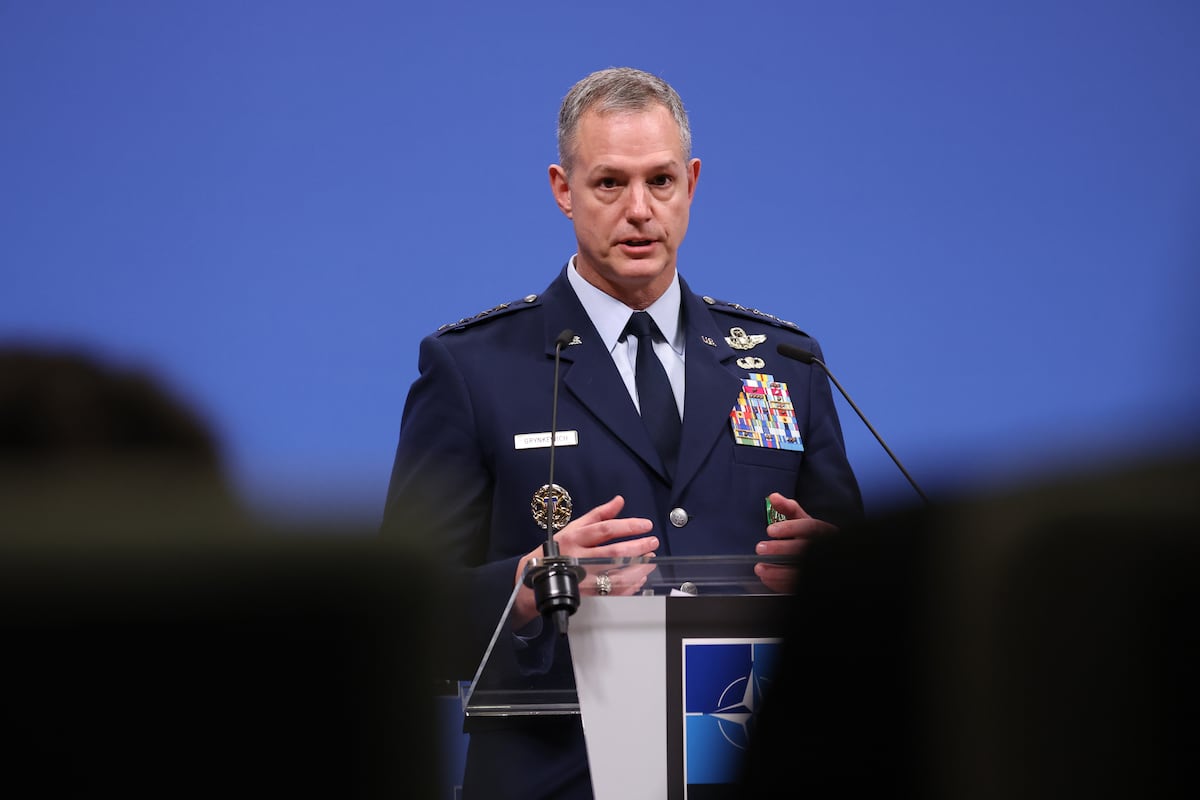

PARIS — Europe should “absolutely” expect additional United States troop withdrawals in the future as European NATO allies strengthen their capability to provide more of their own conventional defense, according to the U.S. general who is the alliance’s top military commander for the region.
The redeployment of U.S. troops from Europe will be an ongoing process for several years, even if there’s no exact timeline, Supreme Allied Commander Europe Gen. Alexus Grynkewich said in a press conference in Brussels on Tuesday, following a meeting of NATO military chiefs.
“What we’re basically saying is, as the European pillar of the alliance gets stronger, this allows the U.S. to reduce its presence in Europe and limit itself to providing only those critical capabilities that allies cannot yet provide,” Grynkewich said. “So we should expect there to be a redeployment of U.S. forces over time as allies build their capacity.”
The remark comes as Polish government leaders expressed concern about the Pentagon abruptly canceling a planned rotation of an armored brigade combat team of more than 4,000 soldiers to the country on NATO’s eastern flank.
The military chiefs discussed the U.S. decision to redeploy the armored brigade combat team, which Grynkewich said doesn’t impact what he called “executability” of NATO’s regional plans. He said the U.S. is withdrawing a total of 5,000 troops from Europe, with the armored brigade combat team accounting for a large part, as well as the cancellation of a long-range fires battalion deployment.
Grynkewich said planning is ongoing to redeploy “additional minor elements” accounting for another several hundred troops.
U.S. President Donald Trump has repeatedly expressed animosity towards European NATO members, prompting concern in European capitals about whether American commitments to the alliance still hold. The Pentagon said earlier this month it will withdraw 5,000 troops from Germany, whose Chancellor Friedrich Merz has criticized Washington’s handling of the war with Iran.
The withdrawal of additional troops is a decision for U.S. political leadership, according to Grynkewich. He said the timeline will “vary broadly” across different capabilities as NATO members meet spending commitments agreed in 2025 in The Hague and as they meet their capability targets.
NATO’s top military commander said a lot has happened since 2022, as the Baltic countries, Poland and “many others have really built up their ground combat power. So there’s substantially more capability in the ground domain than there was previously.”
RELATED
Grynkewich name-checked the Canada-led Multinational Brigade in Latvia, which he said is fully operational and “highly effective,” and noted Germany continues to build up a brigade in Lithuania.
“As allies build up their capability, the United States is able to pull capability back and use it for other global priorities,” Grynkewich said.
The general said he’ll continue work in his joint role as the commander of U.S. European Command and NATO’s top military commander, “to ensure we’ve got the right coverage in the right places to maintain deterrence.”
The conflicts in Ukraine and the Middle East have shown war is now shaped by “speed, mass, software, drones, electronic warfare, space and data, areas where we have a lot to do,” said Adm. Pierre Vandier, Supreme Allied Commander Transformation, at the press conference.
While NATO needs more missiles, artillery shells, air defense, high-end capabilities and stockpiles, those will not be sufficient on their own, according to Vandier. He said legacy platforms are not obsolete, but “the decisive question is the force mix” of combining ships, aircraft and tanks with robots, drones, sensors, software and new effectors.
”More of the same is necessary, but more of the same will not be enough by far,” Vandier said. “If we want mass and speed, we need to know how we can build fast, produce at scale, adapt quickly, and still deliver real operational effect. And we need to identify which part of our industrial base can actually deliver it.”
Read the full article here