
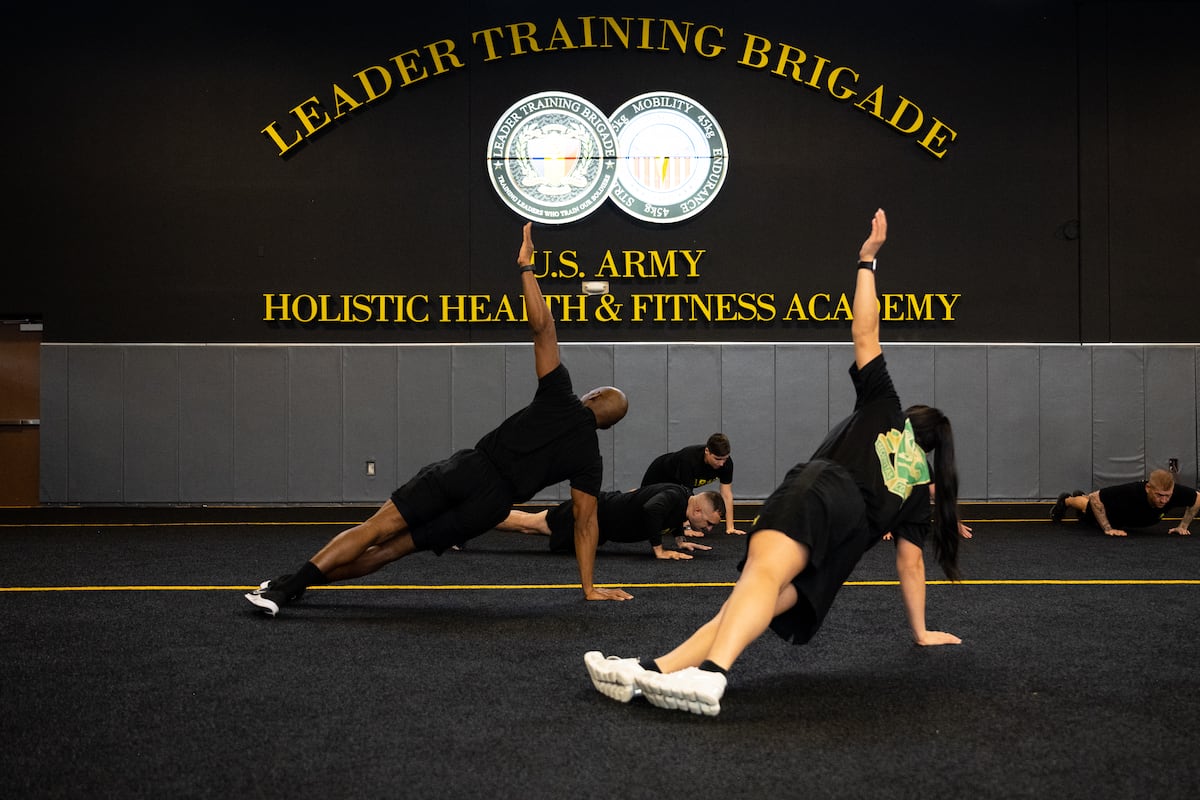

Soldiers in units participating in the Army’s Holistic Health and Fitness program returned to duty faster after musculoskeletal injuries than troops not involved in the program, according to a study published this week.
The study found that soldiers in brigades with the program spent 5.9% less time on limited duty after an injury.
The Army started implementing the fitness program — which is in some ways similar to methods used in other high-level athletics — in 2021. More than 50 brigades were scheduled to receive physical therapists, athletic trainers, dietitians, occupational therapists and strength and conditioning coaches. The first brigades were slated to start the program in 2021, with the final ones implemented in 2025.
Researchers examined around 1.42 million musculoskeletal injuries documented in active-duty soldiers between 2017 and 2025, comparing the outcomes of soldiers in brigades with assigned teams and those without.
The study found that soldiers in brigades with the program were slightly more likely to be put on limited duty after an injury, but returned to duty sooner. The reductions were also higher for lower-body injuries, as opposed to upper-body injuries.
“This result is consistent with enhanced surveillance and earlier identification of injury due to embedded access to rehabilitation personnel. This finding occurred concurrently with shorter recovery duration, suggesting earlier intervention rather than increased injury incidence,” the researchers said.
According to the study, the difference in recovery time increased as the program continued. The first year after the program began, soldiers with the program averaged 2.7 fewer days of restricted duty than those without. By 2025, soldiers in the program averaged 5.7 fewer days on restriction.
The researchers estimated that the decrease in days gave the Army 3.3 million to 4 million workdays with soldiers off restriction, resulting in an estimated $93 to $164 million in labor productivity.
“These findings suggest that employer-sponsored occupational health interventions are a scalable strategy to reduce injury-related absenteeism and enhance workforce productivity, particularly in high-risk industries,” the researchers concluded.
Earlier Army data also suggest that the program could impact suicide rates. In 2023, the service reported 37% fewer suicides among the 28 brigades then equipped with the program.
Eve Sampson is a reporter and former Army officer. She has covered conflict across the world, writing for The New York Times, The Washington Post and The Associated Press.
Read the full article here

![These 8 Guns Are Dominating Sales In America [September 2026 Update]](https://pewpatriots.com/wp-content/uploads/2026/09/1789757524_maxresdefault-330x220.jpg "These 8 Guns Are Dominating Sales In America [September 2026 Update]")