

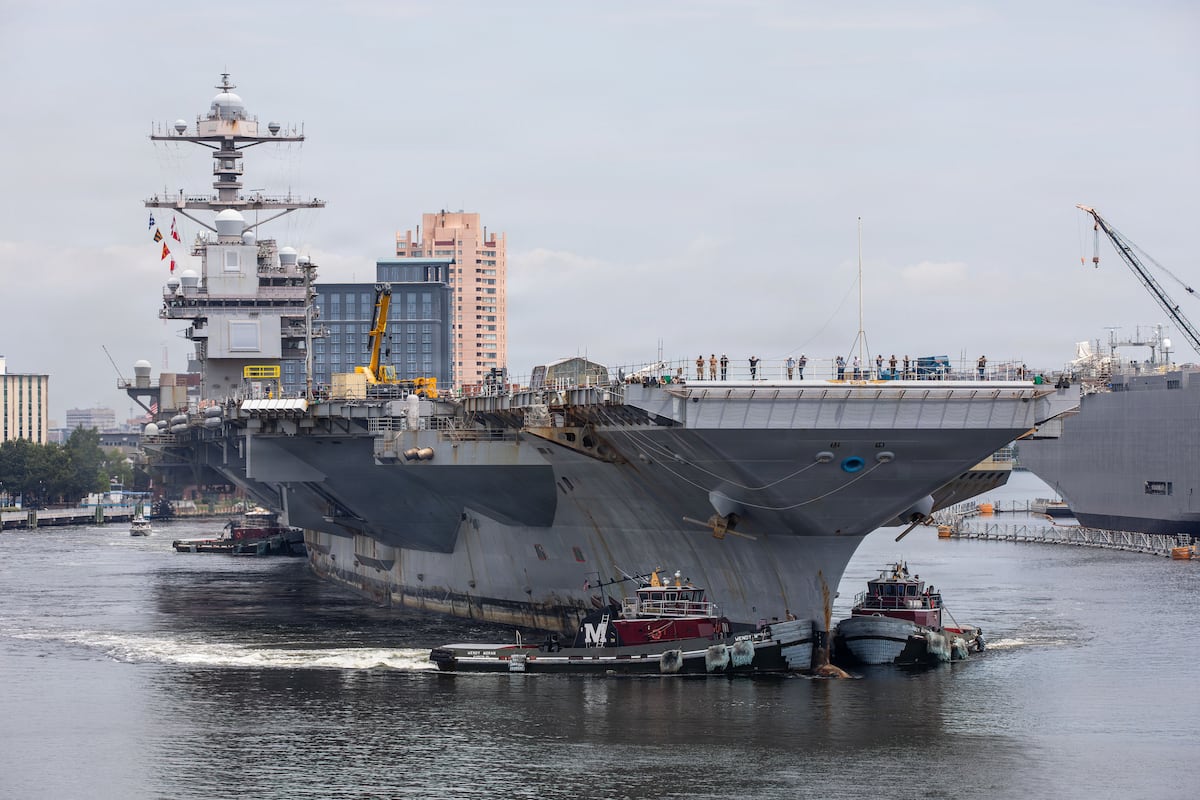

The world’s largest aircraft carrier pulled into Norfolk Naval Shipyard on Tuesday to begin scheduled repairs after wrapping up the longest post-Vietnam carrier deployment.
The USS Gerald R. Ford and its sailors returned to Naval Station Norfolk, Virginia, on May 16 following 326 days at sea that saw a non-combat fire in the main laundry room and significant plumbing issues. The Ford most notably operated in the Middle East in support of U.S. Central Command and Operation Epic Fury against Iran.
“This marks Gerald R. Ford’s first regularly scheduled availability at a public shipyard as well as the first time a Ford-class aircraft carrier has been serviced at NNSY,” the Navy said.
The ship will undergo modernizations and inspections and is set to finish its aircraft carrier availability early, the service said.
The maintenance period will likely address a fire that broke out in the ship’s laundry room March 12, injuring multiple sailors, inducing smoke-related injuries among hundreds of personnel and damaging 100 sleeping berths.
The ship left combat operations and arrived in Greece for maintenance on March 23 before traveling to Split, Croatia, for a five-day port call and eventually returning to sea on April 2.
During its deployment, the ship also faced plumbing issues with the nearly 650 toilets onboard, a result of an issue with the vacuum system that transports and disposes wastewater.
NPR published a report that said the Ford had called for assistance with the damaged toilets 42 times since 2023, with 32 calls coming in 2025 alone.
There were 205 breakdowns with the toilets over a span of four days, NPR reported.
But Chief of Naval Operations Adm. Daryl Caudle said during a Senate Armed Services Committee hearing in May that the problems were exaggerated.
“If that system is operated in accordance with procedure, then it does not clog,” Caudle said.
Riley Ceder is a reporter at Military Times, where he covers breaking news, criminal justice, investigations, and cyber. He previously worked as an investigative practicum student at The Washington Post, where he contributed to the Abused by the Badge investigation.
Read the full article here