
Autonomous boats helped escort a U.S. Army vessel during a recent military exercise, the Army said, in a demonstration of how uncrewed assets are changing maritime operations.
Soldiers from the 125th Intelligence and Electronic Warfare Battalion, 25th Infantry Division, deployed unmanned surface vessels, or USVs, in Casiguran Sound bay, during an exercise with the Philippine Army. The USVs deployed ahead of a U.S. Army Logistics Support Vessel, or LSV, as it neared Casiguran port, the Army said in a June release, observing the environment and transmitting information to personnel on land.
The operation was part of Salaknib 2026, and supported the transportation of Philippine Army personnel and vehicles — including armored personnel carriers — more than 260 miles to Port Casiguran.
The USVs navigated autonomously using onboard sensors to identify potential threats and provide commanders with a continuous picture of the operating environment.
“We deployed the autonomous intelligence, surveillance, reconnaissance boats to provide security for landing craft today,” said Pvt. Caleb Hannah, a soldier from the 125th Intelligence and Electronic Warfare Battalion, 25th Infantry Division. “They escorted the LSV to port from about six miles out, allowing Philippine vehicles to roll onto the dock.”
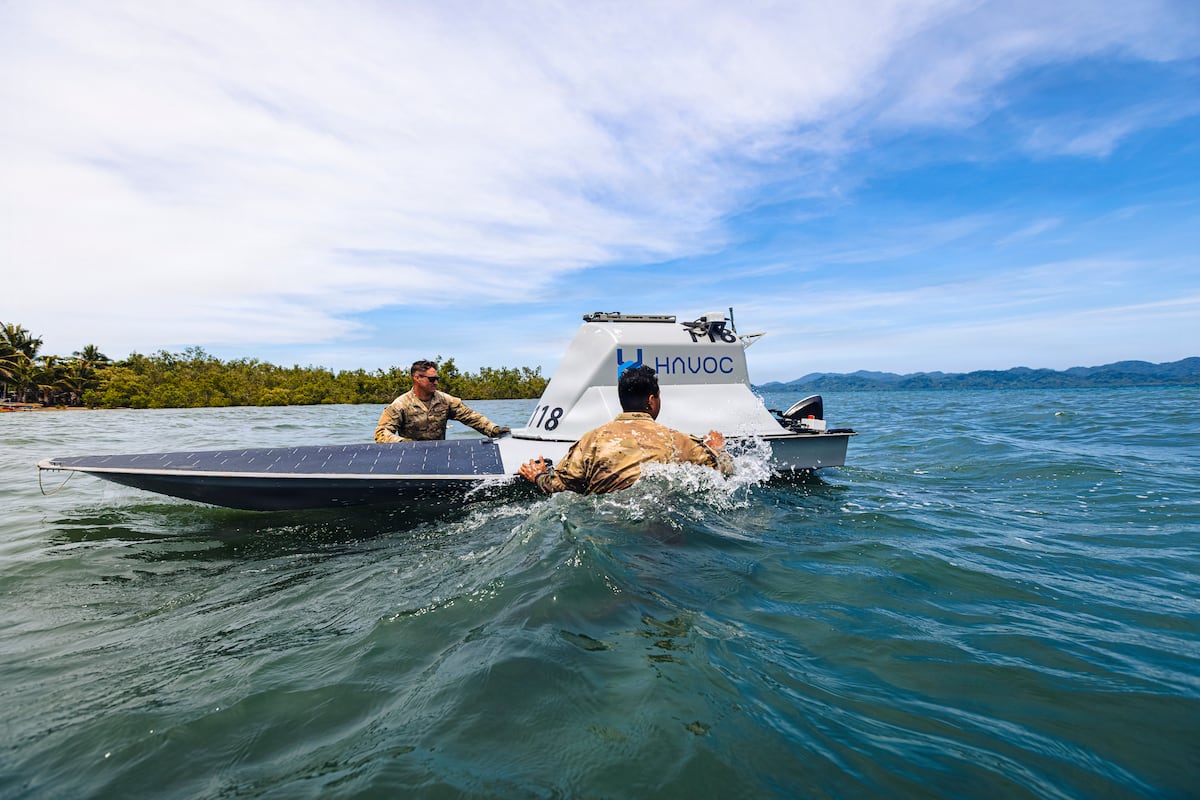
Photos released by the Army appear to show soldiers wading out into chest-deep water to recover a USV with HAVOC branding on its side. HAVOC is a defense technology company that develops autonomous systems.
The demonstration comes as the U.S. military is expanding its unmanned maritime fleet across the Indo-Pacific. Earlier this year, a Navy official said the service expects its fleet of medium unmanned surface vessels to grow from around four vessels in April to more than 30 by 2030, alongside thousands of smaller USVs and unmanned aircraft systems.
“These boats provide situational awareness to commanders with their ability to find, fix, target, kill, and confirm. With the information the USV provides, the commander’s decision-making process has been compressed from hours to seconds,” Ben Outlaw, an industry partner representative supporting the operation, said in the Army’s statement.
News of the exercise comes as the U.S. deployed a USV to help rescue two Army soldiers after their helicopter went down near the coast of Oman. In that incident, a U.S. Navy Corsair operated by 5th Fleet’s Task Force 59 was involved in the recovery. At the time, Capt. Tim Hawkins, a U.S. Central Command spokesperson, said the Task Force had started fielding those drones in the region in late March.
Eve Sampson is a reporter and former Army officer. She has covered conflict across the world, writing for The New York Times, The Washington Post and The Associated Press.
Read the full article here