

The U.S. Air Force wants target drones that can mimic the performance of a variety of aircraft, from stealth fighters and heavy bombers to large and small drones.
The goal is to create a family of drones that can “represent the full range of airborne threats, spanning from inexpensive ‘hobby drones’ to the most advanced adversary fighter and large-scale aircraft,” according to the Air Force’s Request for Information, which has a deadline of Sept. 28.
At the same time, the Air Force desires next-generation target drones that are so inexpensive and easy to manufacture that they can be “treated as attritable or expendable when required.”
As with drones and other new technologies, the Pentagon is turning to private industry for fresh ideas, “including commercial, modified commercial, dual-use, and non-developmental solutions,” the RFI said. “The government is particularly interested in non-traditional, commercially derived, or dual-use solutions that offer advantages in cost, scalability, and simplicity over legacy systems.”
The new target drones are expected to simulate a wide array of capabilities.
For fighters, the drones should have “supersonic capabilities (up to and exceeding Mach 1.6 at 40,000 feet), high-agility/high-G combat maneuvers, precise low-observable Radar Cross-section (RCS) profiles, multi-spectral Infrared (IR) signatures, active RF emissions, and integrated Electronic Attack (EA) capabilities,” according to the RFI.
To simulate C-130-sized multiengine aircraft, the focus is less on high performance and more on “matching the physical scale, slow subsonic flight envelopes, and propeller or turbofan propulsion characteristics of larger multi-engine aircraft. These platforms must prioritize representative physical volume, basic RF/IR emissions, and realistic radar returns to verify missile seeker guidance, and warhead lethality against large-frame targets.”
For even bigger aircraft, such as strategic bombers and AWACS planes, the key is “replicating the massive physical dimensions, multi-spectral thermal signatures, and heavy-aircraft radar strategic threats.”
To mimic big Group 5 unmanned aerial vehicles, the target drone should be capable of flying at 50,000 feet. For Group 3 and 4 UAVs, the targets should be capable of flying at Mach 0.5 to 0.8, and maneuver at 3 to 6 Gs. For small Group 1 and 2 drones, the targets should fly at speeds of less than 150 knots and be capable of drone-swarm operations.
Remote-controlled target drones have been used for nearly a century, including Britain’s Queen Bee — a converted Tiger Moth trainer — in the 1930s.
More recently, the U.S. Air Force has relied since 2007 on the subsonic — and subscale – BQM-167A. At 20 feet long and with a wingspan of 11 feet, it hardly resembles a 67-foot-long Chinese J-20 stealth fighter or a 108-foot-wide Chinese H6 bomber.
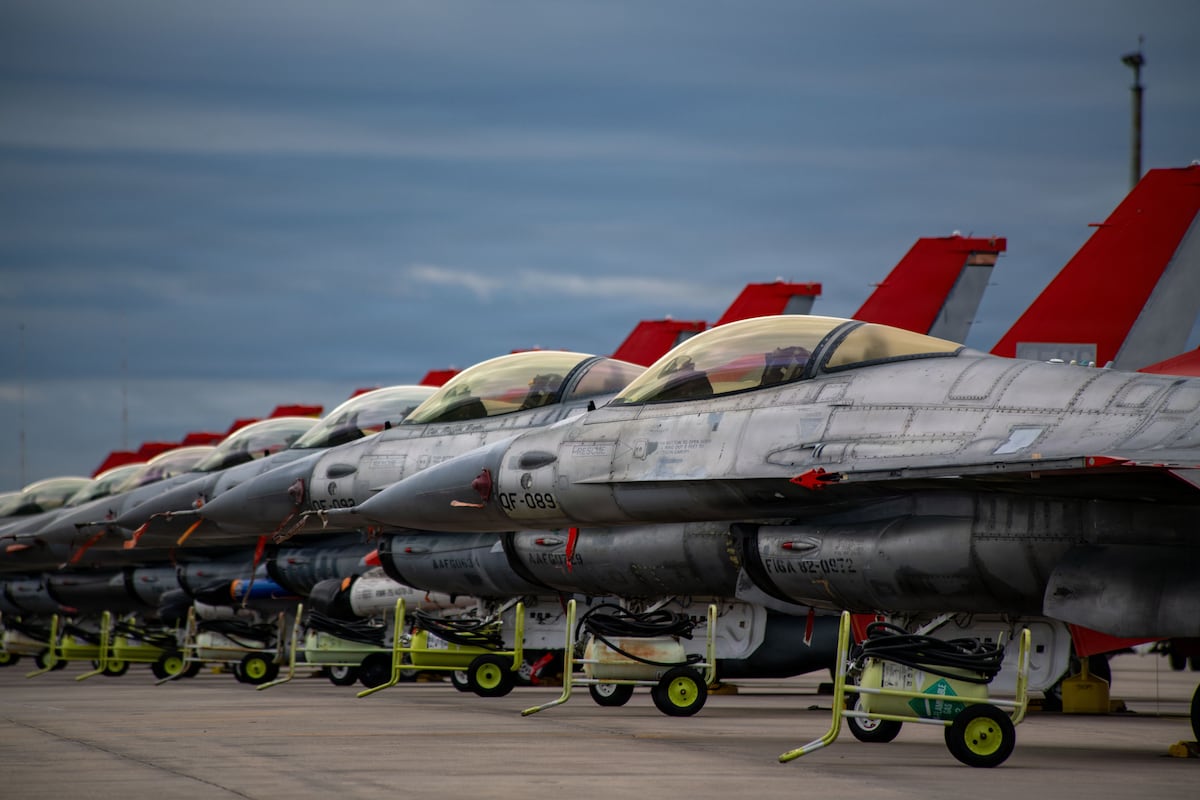
The Air Force also has the QF-16, a converted F-16 that can play the role of a full-sized target, such as a fourth-generation fighter. While a practical way to make use of retired jets, they aren’t meant to simulate fifth-generation stealth fighters or large aircraft, nor are they cheap enough to be expended in quantity.
Michael Peck is a correspondent for Defense News and a columnist for the Center for European Policy Analysis. He holds an M.A. in political science from Rutgers University. Find him at theuncommondefense.com. His email is [email protected].
Read the full article here