

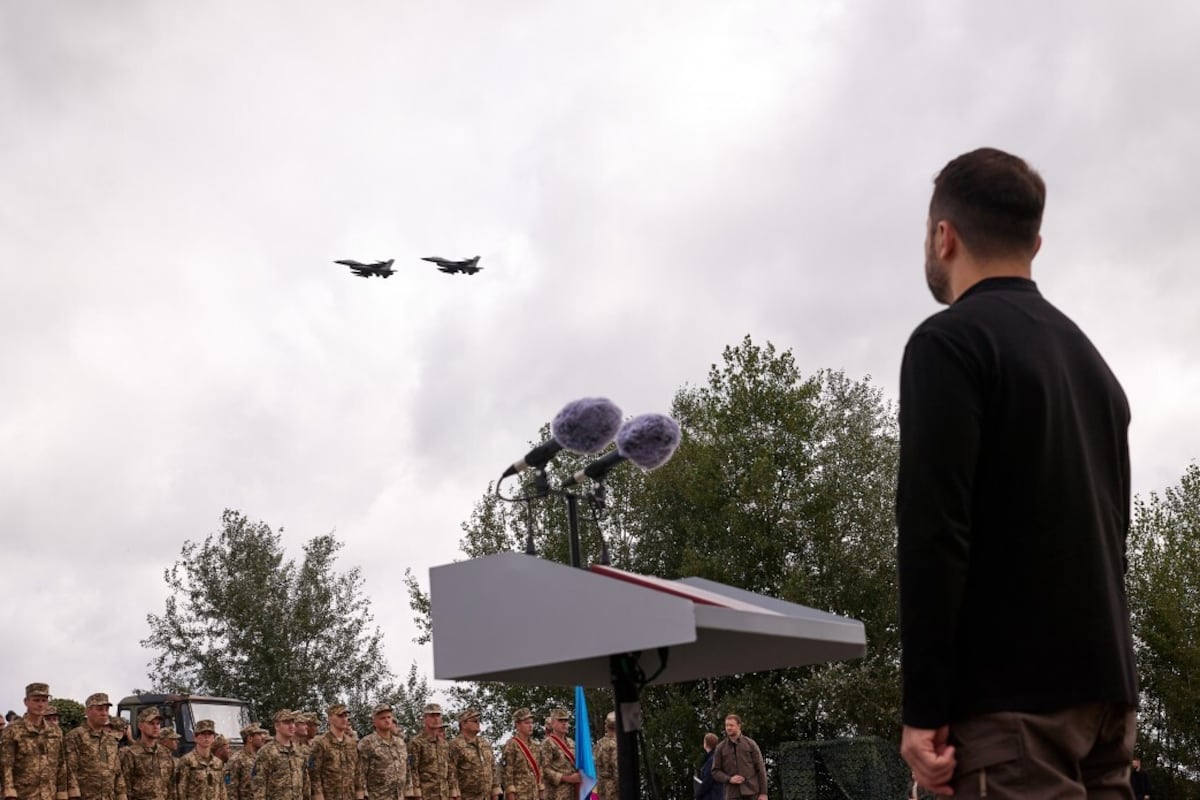

Ukraine’s F-16 fighters have become a crucial defense against Russian drones, but repeated interceptions are wearing out the country’s small fleet.
Ukrainian F-16s have destroyed more than 2,500 Geran and Gerbera one-way attack drones, wrote airpower expert Justin Bronk in an analysis of the Ukraine air war for the Royal United Services Institute, a British think tank.
“[The] use of fighters against such drones has consumed an unsustainable number of airframe flying hours and air-to-air missiles … since mid-2024, when the Ukrainian Air Force received its first Western aircraft and trained crews,” the analysis reads.
“Russian industry produces more than 6,000 [one-way attack] drones per month, and fighter aircraft have only a finite number of airframe hours available before they need time consuming deep maintenance cycles to be performed at a factory by expert technicians.”
Ukraine’s fleet currently operates an estimated 39 F-16s, out of about 79 promised by various Western European nations. Ukraine also flies an estimated four Mirage 2000-5 fighters, out of up to 20 promised by France, plus a few Soviet-era Su-27 and MiG-29 fighters.
The F-16s have been a game changer in the Ukraine air war. They enable Ukraine’s small air force to launch stand-off attacks against ground targets using American-made JDAM and French-made AASM Hammer glide bombs. The threat they pose to Russia’s air force became evident earlier this month, when a Ukrainian F-16 reportedly downed an Su-35 over eastern Ukraine.
Ironically, the F-16 has proven such a capable aircraft that it has become a victim of its own success.
“The F-16 fleet has been over-tasked, mostly by C-UAS [counter-drone] interception duties, for which there is almost unlimited demand over time,” Bronk told Defense News.
The root of the dilemmas is that Ukraine is squeezed between multiple aerial threats.
In addition to drone strikes, Russia has launched numerous cruise and ballistic missiles at Ukrainian cities. Russia has become adept at launching massive combined strikes that begin with waves of drones, followed by cruise missiles, such as the Kh-101, and then ballistic missiles, such as the Iskander-M and Kinzhal.
Ukraine has managed to at least partially tame the drone threat by creating dense belts of short-range air defenses, or SHORAD. These SHORAD belts combine short-range anti-aircraft missiles, anti-aircraft guns, mobile machine gun teams and a variety of homegrown interceptor-drones.
The drawback there is maintaining dense SHORAD coverage along the 745-mile front line — plus defending cities in the rear — with short-range weapons.
“What unites all these mobile air defense teams and counter-drone teams is that their equipment and ammunition is relatively cheap and thus their operations are sustainable,” the RUSI analysis noted. “However, they are relatively personnel intensive to deploy at scale and require both force density and geographical depth to be effective.”
These limitations also point to the difficulties NATO would face in creating its own Ukrainian-style SHORAD system.
“NATO cannot replicate the density of SHORAD defenses that Ukraine deploys for C-UAS coverage, due to the huge personnel requirements of doing so on a sustainable basis,” Bronk told Defense News.
However, NATO could invest in radar-guided anti-aircraft guns to protect key installations, such as airbases and headquarters, and develop cheaper drone-killing munitions for aircraft such as the APKWS II rocket.
Nonetheless, this still leaves Russia’s cruise and ballistic missiles, against which SHORAD is largely ineffective.
As with the U.S. and Israel versus Iran’s missiles, Ukraine must carefully manage limited stockpiles of air defense interceptors like the American-made Patriot and the European-made SAMP/T.
Ideally, Ukraine should rely on SHORAD to stop the drones, while reserving its F-16s for other missions, Bronk argues.
“Other systems need to be used wherever possible for [one-way attack] drones so that F-16 capacity can be used to intercept cruise missiles and deliver strike missions,” Bronk explained. “Within the Ukrainian Air Force inventory, it is by far the most efficient asset for this.”
Bronk believes that F-16 stand-off ground attacks could be even more effective — if Ukraine’s high command was less rigid.
“There is potential for the Ukrainian Air Force to have greater effects if squadrons and wings are given more authority to plan strikes themselves rather than being centrally tasked by Army-centric headquarters elements,” he said.
Michael Peck is a correspondent for Defense News and a columnist for the Center for European Policy Analysis. He holds an M.A. in political science from Rutgers University. Find him at theuncommondefense.com. His email is [email protected].
Read the full article here