

With the ousting of Venezuelan President Nicolás Maduro on Saturday, U.S. President Donald Trump cited the Monroe Doctrine, the 200-year-old lodestar of U.S. diplomacy — which the Obama administration declared dead in 2013.
“We have superseded it by a lot,” Trump told reporters Saturday.
“They now call it the ‘Donroe Doctrine.’ American dominance in the Western Hemisphere will never be questioned again,” he said.
First articulated by President James Monroe during a Dec. 2, 1823, congressional address, Monroe warned European powers to accept that the Western Hemisphere was solely within America’s sphere of interest and it “soon became a watchword of U.S. policy in the Western Hemisphere,” according to the National Archives.
Both Monroe and his secretary of state, John Quincy Adams, feared European excursions within the newly independent Latin America countries and the doctrine was designed to break the New World from the Old.
Decades prior, Adams’ own father, John Adams, who would become the country’s second president, spelled out this fear during the 1782 Preliminary Articles of Peace negotiations between the United States and Britain to British commissioner Richard Oswald.
When taunted by Oswald for being “afraid of being made the tools of the powers of Europe,” Adams replied bluntly: “Indeed I am.”
“It is obvious,” he continued, “that all the powers of Europe will be continually maneuvering with us to work us into real or imaginary balances of power. They will all wish to make us a make-weight candle, when they are weighing out their pounds. Indeed, it is not surprising; for we shall very often, if not always, be able to turn the scale. But I think it out to be our rule not to meddle.”
Since Monroe first uttered the foreign policy, however, the Monroe Doctrine has been codified and used to justify American interventions is Latin America.
Forty-two years later, the declaration, combined with the ideas of Manifest Destiny, “provided precedent and support for U.S. expansion on the American continent,” writes the State Department.
In 1865, the U.S. government, in support of Mexican President Benito Juárez, exerted military and diplomatic pressure that enabled Juárez to remove Emperor Maximilian, who had been placed on the throne by the French government.
The Monroe Doctrine came into its own and acquired its imperialist character, however, under President Theodore Roosevelt and his “Big Stick” foreign policy.
In his 1904 message to Congress, Roosevelt issued his own corollary, tying action to the doctrine.
“Chronic wrongdoing … may in America, as elsewhere, ultimately require intervention by some civilized nation,” he said.
“And in the Western Hemisphere,” Roosevelt noted, “the adherence of the United States to the Monroe Doctrine may force the United States, however reluctantly, in flagrant cases of such wrongdoing or impotence, to the exercise of an international police power.”
Acting as an “international police power” saw the U.S. annex Hawaii, seize Puerto Rico, the Philippines and Guam, intervene in Cuba, Nicaragua, Haiti and the Dominican Republic and help foment Panama’s secession from Colombia to pave the way for the Panama Canal.
The Cold War led to further interventions regarding fruit in Guatemala and oil in Iran, Mark T. Gilderhus, a former diplomatic history professor at Texas Christian University, wrote in 2006.
Couched in rhetoric emphasizing commitments to solidarity and democracy, Gilderhus wrote, the doctrine had “consistently served U.S. policy makers as a means for advancing what they understood as national strategic and economic interests.”
Yet in the latter half of the 20th century, the Monroe Doctrine and empire building fell out of vogue.
Under the Trump administration, however, the policy is back in fashion.
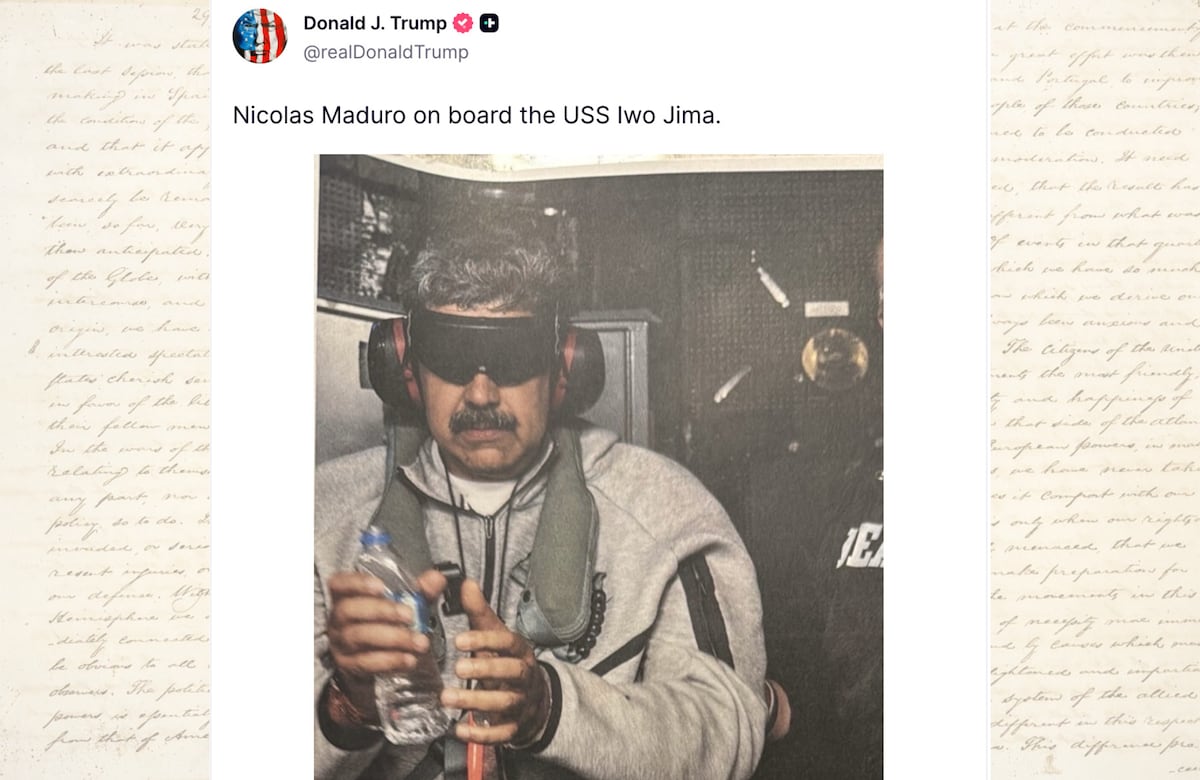
On Saturday, Maduro and his wife, Cilia Flores, were extracted from their home in the capital of Venezuela and arrived in New York to face U.S. charges of participating in narco-terrorism.
Trump emphasized that Venezuela, under Maduro’s rule, had been “increasingly hosting foreign adversaries in our region and acquiring menacing offensive weapons that could threaten U.S. interests.”
On Saturday, Trump defended his Cabinet’s move by citing the Monroe Doctrine, describing Maduro’s actions as being “in gross violation of the core principles of American foreign policy dating back more than two centuries.”
He also cited one factor that appears to be decisive: oil.
“We want to surround ourselves with good neighbors, we want to surround ourselves with stability, and we want to surround ourselves with energy. We have tremendous energy in that country. It’s very important that we protect it. We need that for ourselves. We need that for the world,” he said.
In recent months, Venezuela has emerged as a focus for Trump because, as the Wall Street Journal reports, it encapsulates a number of his priorities, including deporting migrants, fighting drug traffickers, asserting U.S. power across the Western Hemisphere and securing access to the country’s massive oil reserves.
Maduro’s extraction is the most assertive American action regarding regime change since the 2003 invasion of Iraq and the toppling of Saddam Hussein.
“America will never allow foreign powers to rob our people or drive us … out of our own hemisphere,” Trump said. “The future will be determined by the ability to protect commerce and territory and resources that are core to national security.”
Laid out in the November U.S. National Security Strategy, the administration cites the Monroe Doctrine and, like Roosevelt, dubbed its policy in the Western Hemisphere the “Trump Corollary.”
“After years of neglect, the United States will reassert and enforce the Monroe Doctrine to restore American preeminence in the Western Hemisphere, and to protect our homeland and our access to key geographies throughout the region,” the document said.
“We will deny non-Hemispheric competitors the ability to position forces or other threatening capabilities, or to own or control strategically vital assets, in our Hemisphere. This ‘Trump Corollary’ to the Monroe Doctrine is a common-sense and potent restoration of American power and priorities, consistent with American security interests,” it continued.
Maduro’s government has called the American seizure “imperialist.”
“If we normalize the kidnapping of a head of state, no country is safe,” Maduro’s son, Nicolás Maduro Guerra, said Monday.
“Today it’s Venezuela, tomorrow it could be any nation that refuses to submit. This is not a regional problem, it is a direct threat to global stability, to humanity and to the sovereign equality of nations.”
Claire Barrett is the Strategic Operations Editor for Sightline Media and a World War II researcher with an unparalleled affinity for Sir Winston Churchill and Michigan football.
Read the full article here