

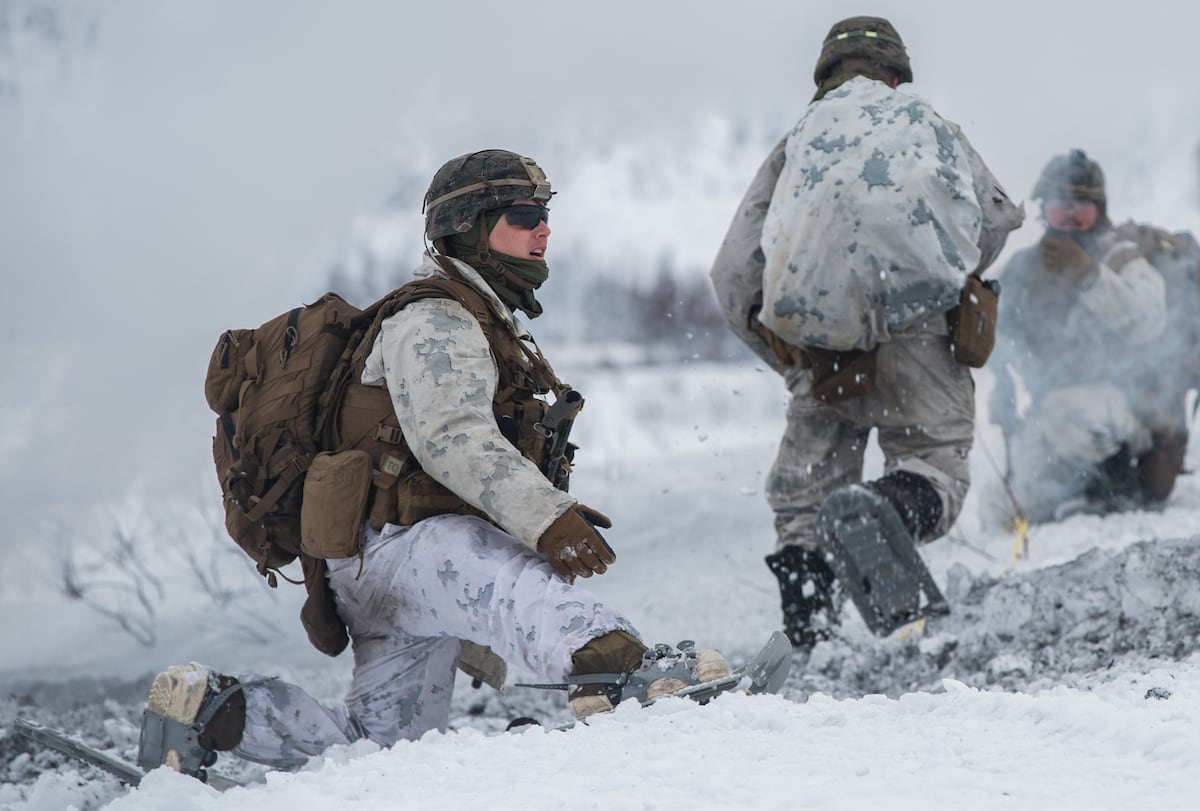

The Marine Corps has issued updated interim guidance for preventing heat- and cold-related injuries by directing commanders to expand training, establish response plans and develop standard operating procedures for operations in extreme weather.
The guidance is considered “interim” because it has not yet been incorporated into the Marine Corps Safety Management System, but it remains in effect until it is formally adopted or superseded.
The new guidance directs commanders and officers in charge to ensure personnel receive training on the causes, prevention and treatment of heat and cold stress injuries. Leaders also must develop standard operating procedures for training and operational activities conducted in hot and cold environments.
Required training includes work-rest cycles, heat flag warning systems, the Wet Bulb Globe Temperature (WBGT) index and the wind chill index. The guidance also stresses the importance of trained medical personnel in evaluating and treating Marines who suffer heat or cold injuries.
In addition to requiring medical personnel assigned to Marine units to maintain rapid response plans and designated cooling or warming areas, the guidance notes that personnel exposed to excessive heat stress may require evaluation by a qualified health care provider to determine whether they have suffered a heat-related injury.
The guidance places particular emphasis on using the WBGT index to assess environmental heat stress. Unlike the standard heat index, which measures only temperature and humidity, the WBGT factors in direct sunlight, wind speed, sun angle and cloud cover, providing a more complete picture of conditions that can contribute to heat illness.
Additionally, the guidance has reporting requirements in that the unit safety representative must enter all confirmed heat or cold injuries into the Risk Management System.
The updated guidance comes as weather-related injuries continue to affect all branches of service.
According to a recent report by the Military Health System, 2,751 servicemen and women experienced heat-related injuries — heat exhaustion and heat stroke — in 2025 with the Marines reporting 641 of them. However, the data also shows that the total number of cases for the Marines dropped from 655 the year before.
As for cold weather injuries, the service reported 107 cases, likewise the second-highest total behind the Army. Those included 40 cases of non-freezing peripheral injury, commonly known as trench foot, 49 cases of freezing peripheral injury, or frostbite, and 18 cases of hypothermia.
According to Task & Purpose, which first reported on the message, this is the first update to the service’s heat and cold injury prevention guidelines in 11 years.
Daniel Terrill is a contributor to Military Times. He’s been reporting on military issues, the gun industry, and the outdoors for nearly two decades. Although writing is his passion, he’s been a Marine, police officer, and, perhaps the most dangerous job of his career, a substitute teacher.
Read the full article here