
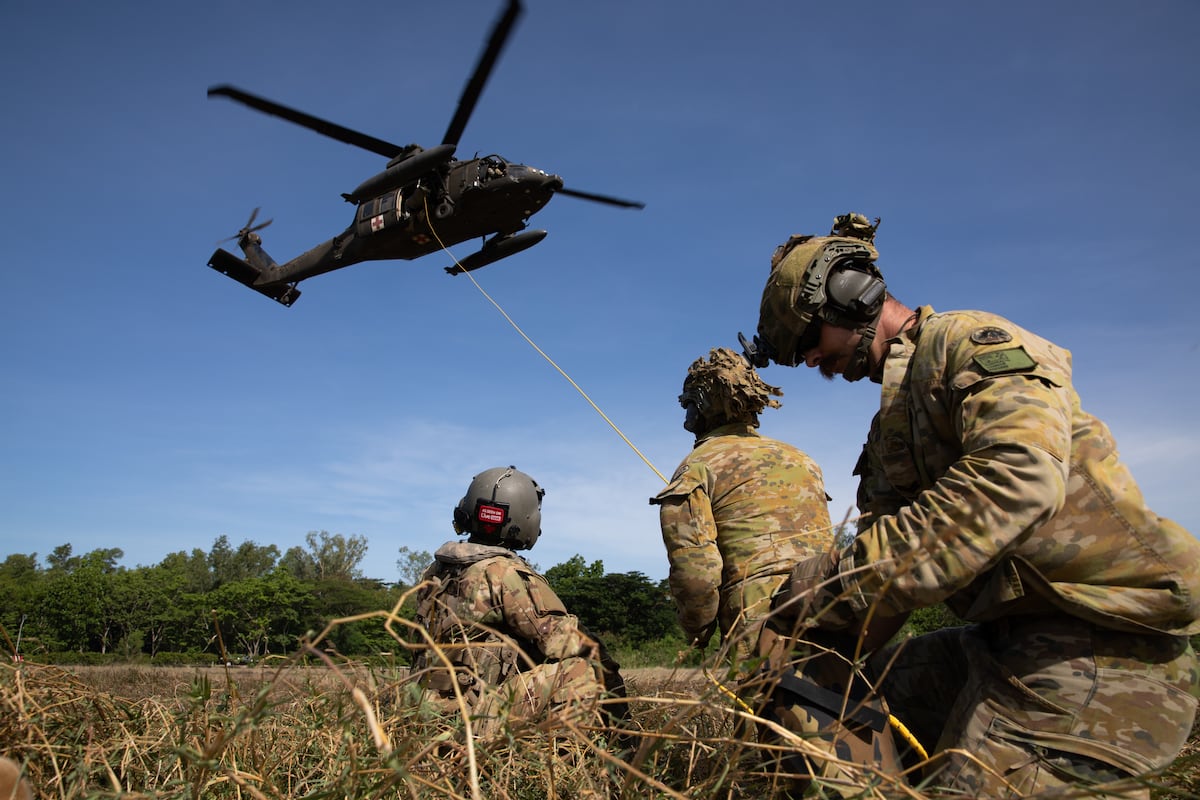

HONOLULU — As the U.S. Army prepares for a possible fight in the Indo-Pacific theater, combat medical teams are seeing vast differences in what treating wounded personnel there would entail compared to recent conflicts.
Looking back at previous wars, such as Iraq and Afghanistan, the U.S. military in 2009 implemented a “Golden Hour” standard which requires medical care and evacuation to a surgical facility to occur within 60 minutes of a traumatic combat injury.
In the Indo-Pacific, that might not be feasible.
Army Lt. Col. Lauren Hamlin, commander of Veterinary Readiness Activity, Hawaii, told Military Times that the region’s distance, contested air and sea lines of communication, weather and limited evacuation platforms could greatly impact timely patient movement and access to surgical care.
Prior to possible evacuation, these challenges necessitate prolonged field care, forward surgical stabilization and medical support for patients, Hamlin said.
“Therefore, the priority in the Pacific is building resilient medical capabilities, both personnel and equipment, that can operate effectively in austere, distributed and contested environments,” Hamlin added.
In a medical care demonstration with the 18th Theater Medical Command at the 2026 Land Forces of the Pacific Symposium and Exposition in Hawaii this month, Hamlin detailed how the Army’s health care system has become more modular for decision making compared to past conflicts.
“Look at battles back in Vietnam, like the old MASH,” she said. “That’s really not the model. They want to have lots of options.”
In the Indo-Pacific, the problem set is different. Medical teams have various locations where they need to be able to set up shop, which requires different capabilities for different islands or spaces, Hamlin said. Commanders, meanwhile, need to have various options to make decisions based on the location’s risk level, she added.
Hamlin listed distance, island geography, limited infrastructure, contested logistics and delayed evacuation timelines as difficulties posed by the region, each of which will cause combat medics to find ways to mitigate challenges creatively.
Solutions include realistic prolonged care training, forward-positioned capability, interoperability with joint and partner forces and cross-training medical teams to “do more with limited manpower and equipment,” Hamlin said.
The battlefields of Iraq and Afghanistan saw the survival rate of combat wounded climb significantly to around 92%, according to the Army, making it the highest rate in the history of warfare.
The increased number of soldiers surviving injuries has been attributed to better training, the advancement of Army medicine and the “Golden Hour” policy, despite dealing with unique injuries from new variations of weaponry such as landmines or improvised explosive devices, or IEDs.
During the simulation, Hamlin noted that it would be more accurate to compare a fight in the Indo-Pacific theater to that of World War II, rather than counterinsurgency operations seen in Iraq and Afghanistan.
“We’re not having isolated incidents. We’re not having rockets shot at us from 20 miles away, [where insurgents are] just kind of hoping to hit something,” she said. “This is more like army on army, so I would argue it would be a very different injury rate.”
Another complication, according to Hamlin, is air superiority. Unlike during the Global War on Terror, medical teams will likely be unable to move a patient to higher levels of care without immense threat.
Hamlin said the combat medical community needs to come up with creative solutions to withstand the patient backload before being able to move wounded to another facility.
One of those explored solutions has come in the form of joining veterinary services with human care, Hamlin said, as the community is “worried that that’s all that’s going to be” available in the expansive region.
Drone Warfare
As unmanned systems become increasingly advanced and integrated within militaries across the globe, autonomy is shifting how the military retrieves and transports casualties.
Drones pose a risk to patient evacuations, Hamlin said, and in turn increase the need for autonomous patient evacuation capabilities in the future.
Hamlin told Military Times that UAVs can improve situational awareness, deliver blood or medical supplies and support triage across dispersed casualty sites.
In a mass casualty scenario, for instance, drones can assist combat medics with moving critical supplies faster than ground assets and reduce the risk to manned platforms in contested areas.
Unlike in Europe — specifically Ukraine — the Pacific poses a unique challenge in that there is no scenario in which a medical unit would place patients on a train or drive them out for evacuation, Hamlin said during the demo. The ability for prolonged care is a necessity, then, considering the Pacific’s reliance on air and boats for transport.
At LANPAC, the 8th Forward Resuscitative and Surgical Detachment demonstrated a care simulation on a cut suit in what would be a surgical unit aboard a vessel.
“We model this on a vessel because that would be the evac route,” Hamlin said. “You would have to use boats or ships to move patients because we’re not sure if we’re going to be able to fly them out in mass.”
To carry patients, the team has been utilizing autonomous small multipurpose equipment transports, or SMETs, uncrewed, eight-wheeled robotic combat vehicles guided with a remote control, Staff Sgt. William Dean, detachment sergeant of the 8th FRSD, said during the demo.
Alongside the SMETs, medical personnel are experimenting using other products that allow them to input grid coordinates to move patients to specific locations, like Ukraine has been doing. This development, Dean said, would be a “huge win.”
Ukraine’s military, which has increasingly used unmanned systems in frontline combat, has also been ramping up the use of unmanned ground vehicles in high-risk areas for casualty evacuations to remove the exposure of medical teams to hostile fire.
The team is also looking into telemedicine-enabled systems, autonomous resupply and medical decision tools supported by artificial intelligence, Hamlin told Military Times, with the goal of increasing reach, reducing personnel risk and sustaining care when movement is delayed or dangerous.
Cristina Stassis is a reporter covering stories surrounding the defense industry, national security, military/veteran affairs and more. She previously worked as an editorial fellow for Defense News in 2024 where she assisted the newsroom in breaking news across Sightline Media Group.
Read the full article here