

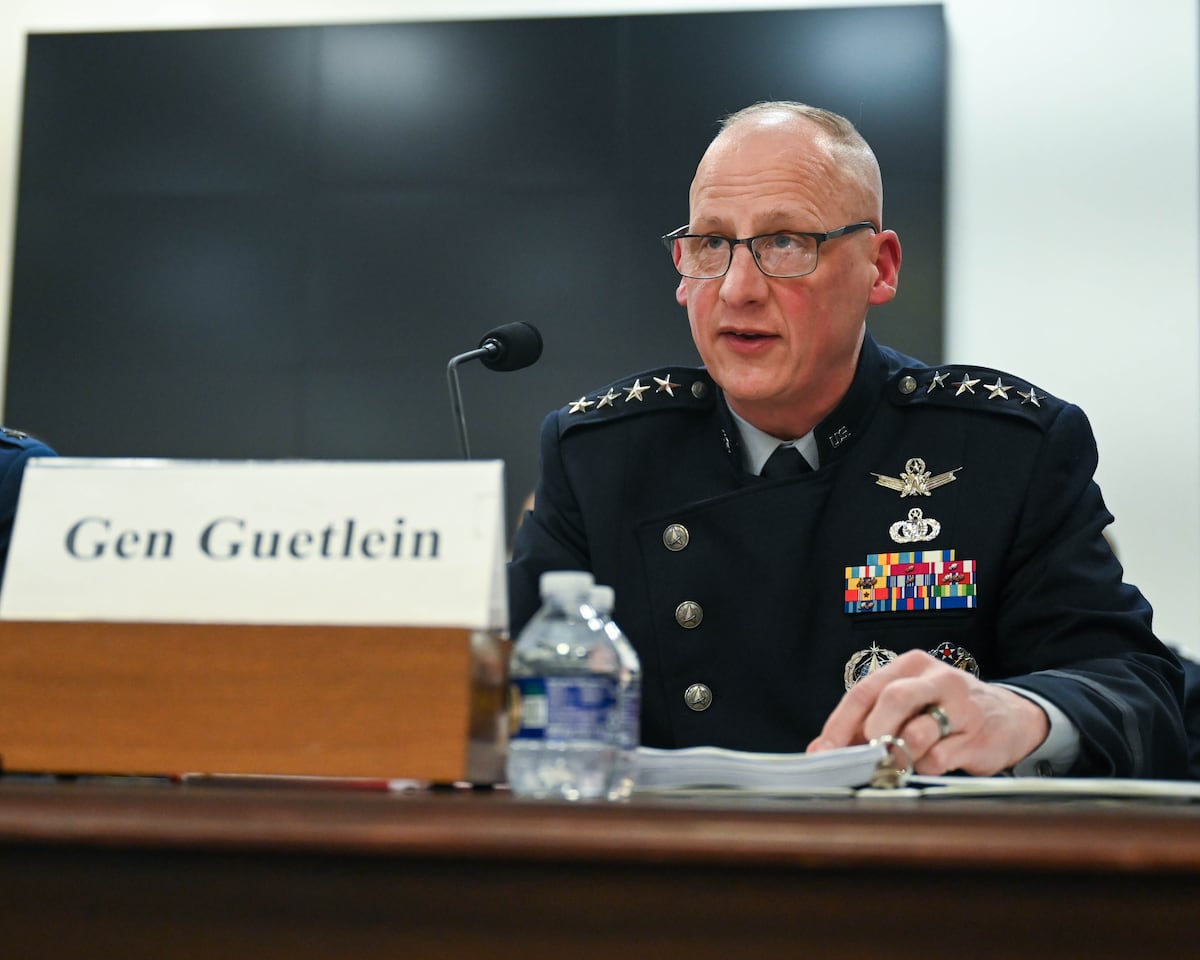

The Space Force general overseeing the White House’s ambitious $185 billion national missile shield initiative redoubled on promises to deliver an operational capability by mid-2028, even if it means changing plans and incorporating different technologies to do so.
Gen. Michael Guetlein, the appointed czar for the United States’ “Golden Dome” initiative, appeared before the Senate Armed Services Committee Monday, telling lawmakers that plans to build the shield were proceeding apace, despite concerns in Congress about its funding and a dearth of regular updates.
In January, Rep. Jeff Crank, R-Colo., the co-chair of the House Golden Dome Caucus, told Military Times that he had found the wait for delivery of an actionable framework from the White House “frustrating” and worried missing the 2028 deadline would endanger the entire effort.
Guetlein said he had met with representatives from more than 400 potential contractors over the past six to eight months and believed the project was poised to deliver on time.
“We have built the foundation of Golden Dome upon a scalable, modular architecture, using affordable elements and taking advantage of competition innovation from industry to deliver those elements,” he said. “And we have scaled it so that it is multi-layered and integrated. If any component of the architecture cannot deliver on time, we have pathways to pivot away from that and embrace a different technology.”
While Guetlein did not elaborate on what such a pivot would look like, he said partnerships with industry were progressing quickly as the project advanced. Last week, he said, leaders had stood up an “ecosystem hub” that he described as a “one-stop shop” for doing business with Golden Dome.
“It’s a single point of entry. It includes two-way communications to have transparent dialog back and forth. It has strategic matchmaking,” he said. “I can connect them to anybody in the federal government that may be in need of their services or their capabilities. It has a security and resilience element to it.”
He added that the Pentagon had hired data analysis companies to stress-test supply chain resilience and anticipate threats so they can be thwarted before they arise.
“We are embracing industry like we’ve never embraced industry in the past,” Guetlein said.
Sen. Angus King, I-Maine, expressed doubt about the feasibility of delivering a comprehensive missile defense shield, even at the eye-watering cost of $185 billion. He noted that, according to the testimony of Army Gen. Francisco Lozano, portfolio acquisition executive for Fires, point defense of the U.S. territory of Guam alone cost $3.5 billion.
Guetlein said Guam’s Enhanced Integrated Air and Missile Defense System, which includes Patriot missile batteries, Terminal High Altitude Area Defense (THAAD) and Aegis weapons systems, and is expected to be fully operational by next year, is not an apt comparison to the networked defense that Golden Dome will represent.
“If you look at the way we fight the away game, every one of our weapon systems has to be self-contained, so that it can operate in a bare-bones environment, that it can operate independently, disconnected from the larger enterprise,” he said. “That is not the way we need to defend the United States.”
King asked the Golden Dome czar to get more specific about what the system would actually be.
“We are integrating and networking an array of effectors and an array of sensors using next-gen technology to get a greater magazine depth at a lower cost per intercept,” Guetlein said.
For one specific program, the Next-Generation Interceptor made by Lockheed Martin and under the purview of the Missile Defense Agency, work continues, said Air Force Gen. Health Collins, MDA’s director. The Pentagon initially asked MDA to start fielding interceptors by 2028, though Collins noted the program faced a “replan” 18 months ago due to concerns with the solid rocket motor.
By the end of 2026, he said, “We are on track for the all the ground full system critical design review to close the design phase of the next-gen interceptor program and completely move into the manufacturing and test phase of that as we drive towards the first first flight test in 2029.”
No major design issues remained, Collins said, although a few components including the solid rocket motor still needed to be debugged.
“We are working to buy down those risks and move forward as quickly as possible to make sure we pull the date as far to the left as possible,” he said.
Read the full article here