
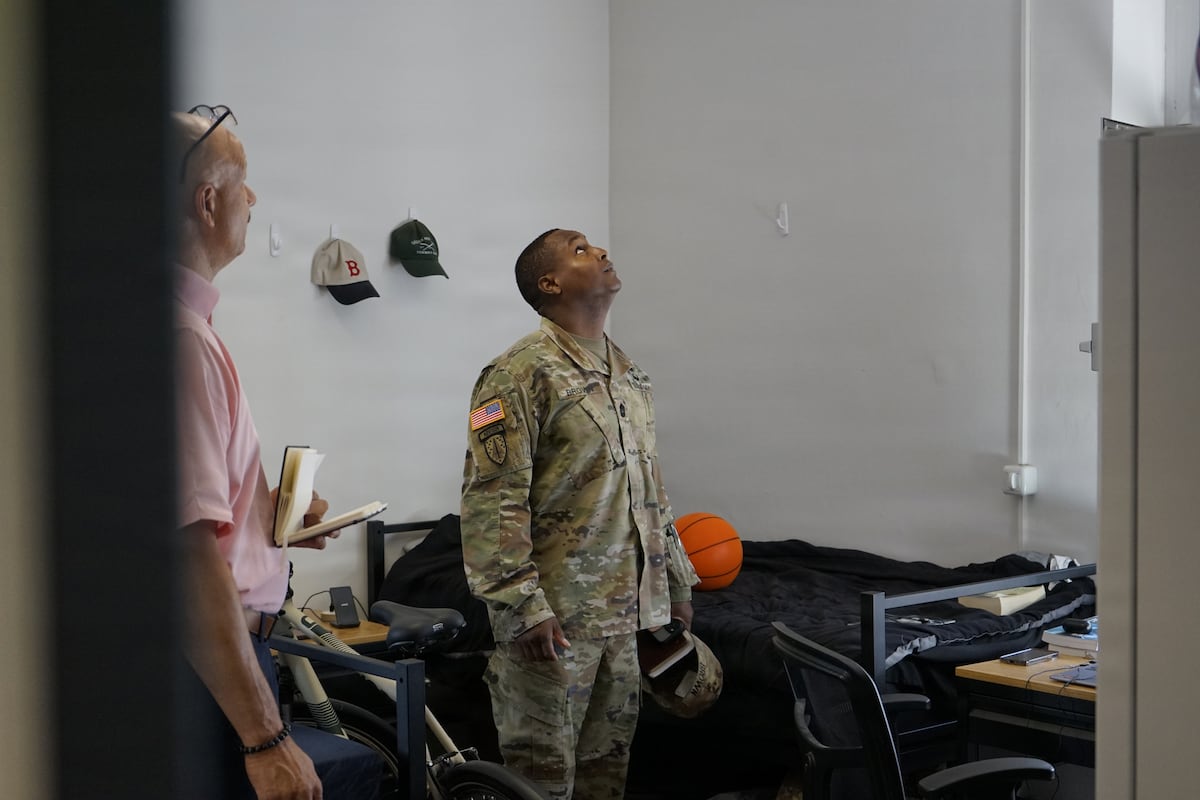

Command Sgt. Maj. Nema Mobarakzadeh recalls an occasion at a prior command in which a battalion sergeant major approached him, outraged that his soldiers hadn’t had running water in their barracks for a week.
Mobarakzadeh asked the sergeant major for the number of the work order he’d put in to address the problem, but got only confusion in response.
“Not one person in the formation put a request in,” Monarakzadeh, now command sergeant major of U.S. Army Western Hemisphere Command, said during a call with reporters on Monday.
“And so I chewed him out a little bit and let him know that this was actually his fault, that we could have got this fixed rather quickly, but how is [the Army Directorate of Public Works] supposed to know that there’s something wrong with your barracks if you haven’t put a work order in?” Monarakzadeh continued. “And of course, we got it fixed the same day.”
It’s experiences like those, Mobarakzadeh said, that provided the impetus for the Army’s new “NCO’s Barracks Guidebook,” released Tuesday.
The 20-page guide, with AI-created icons and illustrations, includes responsibility checklists and links to regulations and policy, as well as vignettes about how to handle, for example, the discovery of suspected drugs in a barracks room or helping a unit properly close out a barracks ahead of a deployment.
What it’s not, leaders emphasized during the call, is a set of new rules or policy. Rather, they said, it’s a repository of information for noncommissioned officers who might not be getting, or retaining, the right training in the first place.
“A lot of this information is new to some of these leaders because we gathered best practices from so many places, and so they might not be ideas that they’ve heard or considered before,” Mobarakzadeh said. “And so it’s just kind of sharing all that information across the formation.”
‘Beans, barracks and bullets’
The guide went through 59 drafts before publication, Mobarakzadeh said. The hope is that it creates a common understanding of what’s expected of barracks managers, and particularly the senior NCOs, when troops encounter problems with their living quarters.
“There was also a time during the Global War on Terror where we outsourced this; we had a number of civilian barracks managers … and they fulfilled many of these responsibilities,” he said. “So you have some NCOs that maybe have an education gap, where they didn’t learn how to do this when they were more junior NCOs, and now they’re in those first sergeant and sergeant major roles.”
“There was a time [when] we talked about, NCOs are responsible for beans, barracks and bullets, and you just don’t hear people talk about those responsibilities as much anymore,” Mobarakzadeh added. “And so this is one step into kind of getting that back.”
The Army has come under scrutiny in recent years for the condition of its on-base housing, with watchdog reports in 2023 showing plumbing disasters, cracked sewer pipes, black mold and vermin. The same year, an Army two-star general drew more criticism when he said that, at his Texas base, the problem was “adulting.”
“I will tell senior leaders ‘I don’t have a mold problem, I have a discipline problem,’” said Maj. Gen. James P. Isenhower III, then commanding general of the 1st Armored Division.
Last month, though, a new government watchdog report found that some barracks were still “chronically neglected” because of underfunded maintenance.
Last year, Defense Secretary Pete Hegseth announced the launch of a new Barracks Task Force with more than $1 billion in investments to improve troops’ living conditions around the world.
Command Sgt. Maj. Jacinto Garza, senior enlisted leader of Army Materiel Command, suggested that troops haven’t been effectively familiarized in the past with housing procedures and expectations.
“This is no different than when our kids go off to college and live in dorms and in apartments. There’s an adjustment that needs to take place,” he said. “Our young soldiers come into the Army. They live on our Army installations. They’re inside of our barracks, and they have to assimilate to the standard operating procedures of our barracks, which they deserve to be educated on.”
During a six-week pilot program with the 101st Airborne Division at Fort Campbell, Kentucky, this summer, first sergeants were asked to read the new guidebook and assess shortcomings in existing knowledge-sharing around barracks management, Mobarakzadeh said.
“You can’t expect NCOs to do things that you haven’t trained them to do, whether it’s run a rifle range or inspect a barracks, and it’s a lot harder than you think,” he said. “Like, how clean is clean enough? What things are you looking for? We have the whole example of contraband. What do you do when you find contraband?”
A company that participated in the pilot added new barracks inspection training to in-processing as a result.
The leaders did acknowledge that most bases have a shortage of public works staff, leaving the onus on troops to report problems and possibly follow up multiple times to make sure barracks problems are addressed.
“Ultimately, if the NCO doesn’t put the work order in, and then doesn’t continue to escalate things and say, ‘Hey, like I’m tracking this work order, it’s overdue, and no one’s here’ … you know, the squeaky wheel,” he said. “You know how that goes, and so that’s our part of it.”
Read the full article here