


Army leaders struggled Friday to respond to congressional furor over the Pentagon’s decision to abruptly cancel a deployment of more than 4,000 soldiers to Poland this month.
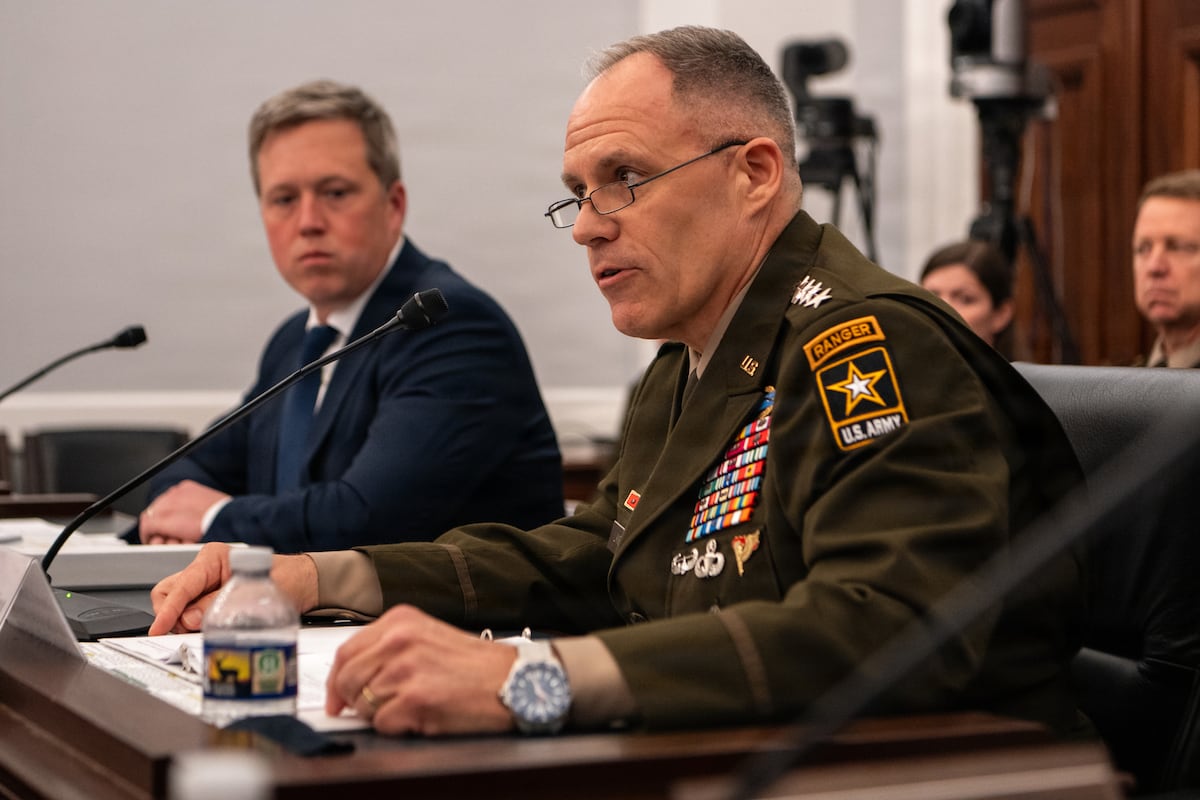
Acting Army Chief of Staff Gen. Christopher LaNeve said in an Army budget hearing that the order to halt a planned 9-month rotation to Europe by 2nd Armored Brigade Combat Team, 1st Cavalry Division to Eastern Europe came from Defense Secretary Pete Hegseth.
LaNeve and Army Secretary Dan Driscoll said they were informed of the order and had been consulted, but they wouldn’t provide the exact timing of the decision. On May 1, the unit had cased its colors in preparation for deployment, dispatched its advanced team and launched its equipment overseas.
Soldiers began discussing the decision to scrap the deployment publicly early Tuesday morning; the order was confirmed Wednesday by Army Times and other news media.
LaNeve said the decision was made “in the last two weeks” by the Defense Department and Gen. Alexus Grynkewich, commander of U.S. European Command and the NATO Supreme Allied Commander Europe.
LaNeve and Driscoll downplayed the move as part of routine manning reviews conducted throughout the year.
“We are constantly in contact with [the Office of the Secretary of Defense] and the combatant commanders … and this is not meant to hide the ball,” Driscoll said during a House Armed Services Committee hearing.
“This type of conversation is going on throughout the year, every single year, and the Army is always ready to move people and things based off combatant commander and Secretary of War preferences,” Driscoll added.
But lawmakers questioned the timing and the reasons, lambasting the order that Rep. Don Bacon, R-Neb., said sent a “terrible message to Russia and our allies.”
Bacon said he had spoken with Polish leaders who were “blindsided” by the decision and understood that Grynkewich had expressed reservations to the order, saying that it was not without risk.
“This is a slap in the face to Poland. It’s a slap in the face to our Baltic friends. I think it’s a slap to the face in this committee, because we’ve put floors and restrictions on the Pentagon on further reductions in Europe because of what they did with Romania,” Bacon said.
CNN reported Thursday that Hegseth made the decision in relation to the administration’s efforts to pressure Europe to increase its own defenses.
CNN also reported that Hegseth’s order canceled a deployment of 3rd Battalion, 12th Field Artillery Regiment to Germany later this year and a command that oversees long-range rockets and missiles will be removed from Europe.
The news follows an announcement May 1 that the U.S. would withdraw 5,000 troops from Germany — a decision Pentagon officials said was made following a review of “theater requirements and conditions on the ground.”
But critics say the withdrawal is retribution for NATO countries deciding not to join the U.S. in attacking Iran. President Donald Trump repeatedly has criticized NATO countries for not investing more in their own defense and said in March that NATO would face a “bad future” if they didn’t help defend the Strait of Hormuz.
“If there’s no response, or if it’s a negative response, I think it will be very bad for the future of NATO,” Trump told the Financial Times.
Army leaders did not say how many soldiers were affected by the decision or provide the number of personnel in the advanced echelon that now must return to Fort Hood, where the brigade is based.
The order has upended the lives of at least 4,500 soldiers, however, many of whom made preparations to vacate homes and apartments, store belongings and relocate their families.
The order also cost money: in a text message reviewed by Army Times Tuesday, a brigade member estimated the cost and retrieval of equipment at $4 million.
Acting Pentagon Press Secretary Joel Valdez said Thursday the decision was “not an unexpected, last-minute decision,” but lawmakers pushed back on that assessment, with Rep. Austin Scott, R-Ga., saying he didn’t see how the “statement can be true.”
“These are major decisions that appear to many of the members of this committee to be last-minute decisions,” Scott said.
LaNeve and Driscoll noted that in their roles as chief of staff and secretary, their jobs are administrative and they have no authority in operational decisions.
LaNeve’s multiple references to the law that dictates the structure of the armed forces — and the pair’s lack of response — irritated several committee members.
“We have been very focused on this committee about force posture, and EUCOM in particular not being disturbed, particularly without — what the statute requires — is consultation with us, and we didn’t get that, so we don’t know what’s going on here, but I just tell you we’re not happy,” said Committee Chairman Mike Rogers, R-Ala.
“It is a pretty dramatic decision to, at the last minute, pull a team that you’re trying to send over there,” agreed Rep. Adam Smith, D-Wash., the committee’s ranking member. “If there’s some strategy behind it, then you guys ought to know, and you ought to be able to communicate it to us.”
The U.S. has roughly 80,000 service members in Europe.
European Command did not respond to a request for comment by publication.
Patricia Kime is a senior writer covering military and veterans health care, medicine and personnel issues.
Read the full article here