


With any air left in lungs likely heaving from adrenaline, the crew members may have blown bubbles, feeling which way the small pockets of air traveled against their face. Submerged in darkness and feeling around a cockpit becoming a watery tomb, the direction of the bubbles may have told the disoriented helicopter crew the direction of the only thing that mattered: up.
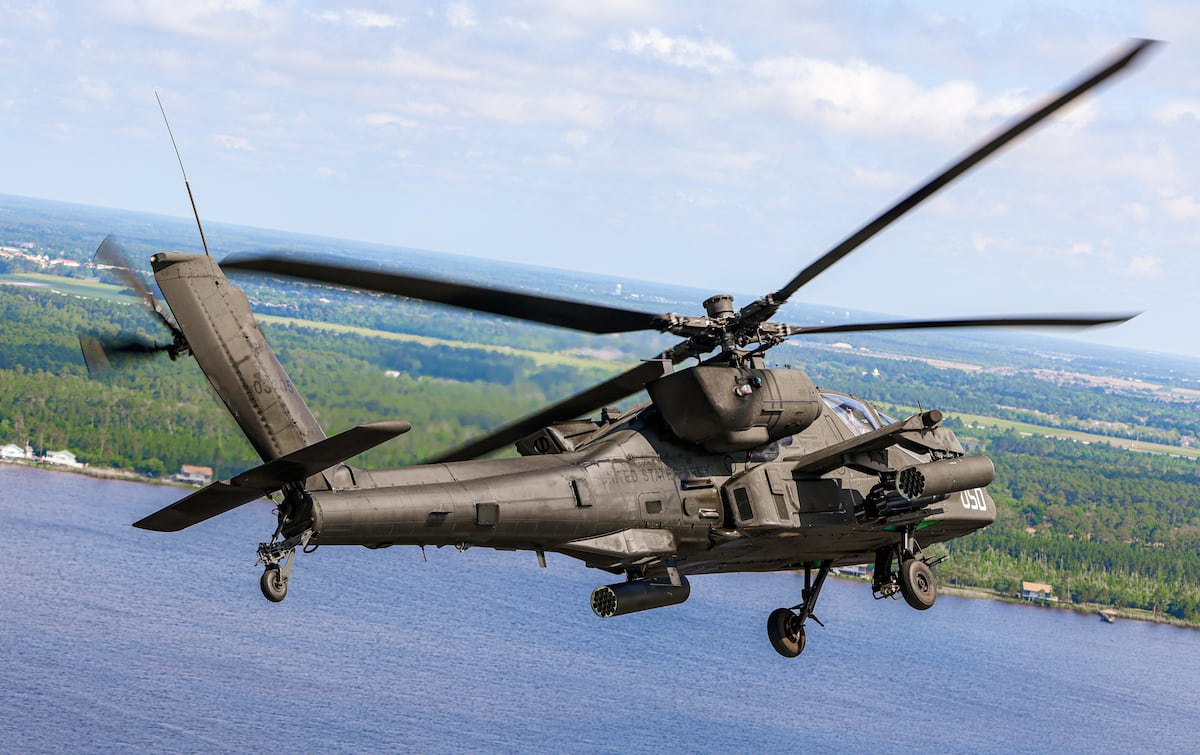
An attack helicopter went down off the coast of Oman this month after a Shahed drone engaged with the aircraft. Though the Pentagon said that its two crew members were rescued by an unnamed surface vessel hours later, public details surrounding the incident remain sparse.
The military’s investigation may ultimately determine what happened between the Apache and drone, but for experts and analysts, the event is a snapshot into how warfare is changing: attack helicopters, once the apex predators of the battlefield, must learn to navigate an ecosystem crowded with unmanned systems that are smaller, cheaper and deadlier than ever before.
The interaction itself seemed an anomaly.
Iranian Shahed-136 drones are typically programmed to fly to set coordinates before launch, which makes them adept at striking targets that do not move, according to Kelly Campa, Middle East Team Lead at the Institute for the Study of War.
“A Shahed hitting a helicopter is highly unusual,” Campa said, noting that Russia has increasingly used remotely guided Shahed variants capable of striking moving targets, like trains.
Campa added that Russia, however, generally has not used those variants to attack aircraft without additional modifications like small missiles, and Iran has not publicly demonstrated similar capabilities.
The unusual nature of the incident — and the scarcity of publicly available information — has made drawing definitive conclusions difficult.
Kelly Grieco, a senior fellow at the Stimson Center, said several explanations for the Apache’s downing are plausible.
The helicopter may have collided with the drone while attempting an intercept, interacted with a more advanced variant than the baseline Shahed design or encountered a drone with a proximity fuse, which detonates near a target instead of on contact.
“The fact that both crew members survived and appear to have made a controlled water landing argues against a direct impact with the warhead,” she said, because if a drone’s warhead blasted into the Apache and detonated, the damage would likely be catastrophic and unsurvivable.
To some analysts, the more pressing question is not what happened between the Apache and drone, but what the incident says about the helicopter’s place in modern warfare.
Apaches, heavily armed to destroy tanks and support ground troops, have historically occupied a fearsome skyward position atop the battlefield hierarchy. However, experts say the proliferation of increasingly capable unmanned systems is challenging that dominance.
Doug Birkey, the executive director of the Mitchell Institute for Aerospace Studies, said the incident is a warning sign after operating in relatively permissive environments during the wars in Iraq and Afghanistan.
“This should be the last fight where we use a lot of legacy constructs, technologies, etc.,” he said, calling the conflict a “transition” into a different way of war.
“It’s time to move on to some newer capabilities and ways of warfighting,” he said.
The Army is moving in that direction, and in March, the service received its first pilot-optional Black Hawk helicopter for testing.
Birkey also pointed to the need to couple crewed-capabilities with uncrewed assets.
“Could you partner that Apache with an uncrewed asset to net similar effect?” he asked, adding that the military could “keep the human cognition and some of those mission capabilities proximate, but you don’t put them in the immediate line of fire.”
Those changes may already be taking shape. One expert sees the early June incident as evidence that developments associated with the war in Ukraine may be appearing elsewhere.
“It was the Shahed being used as anti-helicopter,” said Mark Cancian, a retired Marine colonel and senior advisor at the Center for Strategic and International Studies. “That had happened in Ukraine. It had not happened in the Gulf.”
Apache helicopters routinely fly missions over and around the Strait of Hormuz, Cancian said, attacking Iranian speedboats and shooting down drone threats.
The helicopters can still do those things, he added, but doing so may require more controls — like potentially moving the aircraft in groups — and less freedom than in the past.
For crews, that means operating in an environment where the margin for error is shrinking and the risks are heightened.
One helicopter pilot who underwent underwater escape training recalled being taught to expect disorientation and complete darkness while trying to egress from an inverted cabin after an aircraft goes down in water and rolls over.
Before the training, Kurt Rosell described the experience as his “biggest fear.”
And while exactly how the two rescued crew members survived remains undisclosed, they certainly trained for the risk of going down over water: a scenario with a water-filled cabin where there was only one certainty: bubbles always rise.
Eve Sampson is a reporter and former Army officer. She has covered conflict across the world, writing for The New York Times, The Washington Post and The Associated Press.
Read the full article here