

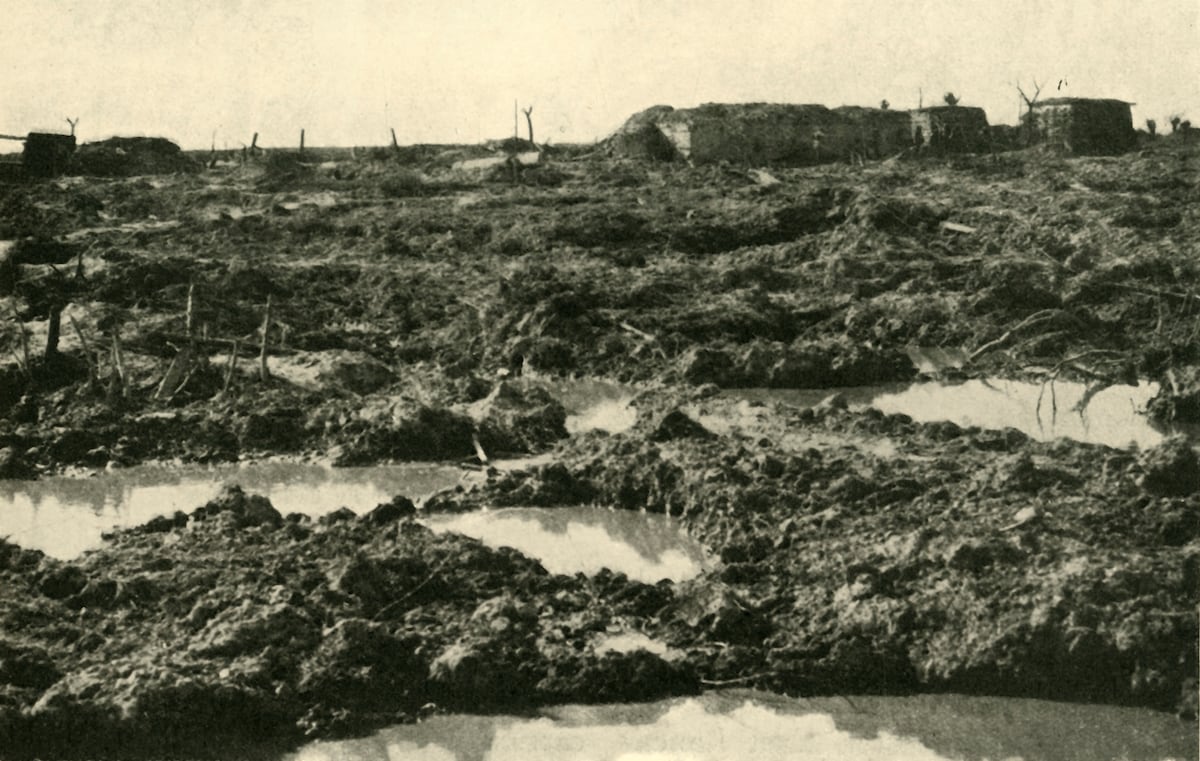

Published in January 1929, “All Quiet on the Western Front” sold a million copies in Germany in its first year and two million around the world.
Just a little over a decade after World War I ended, Erich Maria Remarque’s readers found themselves behind the German front lines, empathizing with German soldiers who had once been mortal enemies to the Americans, British and the French.
Like the outcropping of surrealism after WWI, “All Quiet on the Western Front” opened up a new genre of books for veterans to process what they had gone through.
“The novel attracted global audiences in its own time — and continues to do so nearly a century later — because it lays bare features identifiable in virtually any war: deprivation, terror, trauma, kinship, black humor, alienation from society, and (usually) some questioning of the cause,” Samantha Power, Pulitzer Prize-winning author and former U.S. ambassador to the U.N., writes in the forward of the book’s most recent translation.
However, while it is one of the most famous books to come out of WWI — or any war for that matter — “All Quiet on the Western Front” has only been translated twice from German to English. Once in 1929 by an Australian; the second translation, from 1993, is available only in the United Kingdom.
Arthur Wesley Wheen’s 1929 edition, despite its numerous mistranslations and stylistic flaws, is the dominant one today, having been the only one available in the U.S. for almost one hundred years.
Maria Tatar, the John L. Loeb professor of Germanic languages and literatures and chair of the Committee on Degrees in Folklore and Mythology at Harvard University, saw a gap in the literature and painstakingly restored the novel with contemporary prose while remaining faithful to Remarque’s voice.
With “All Quiet on the Western Front” now in the public domain, she writes in her foreword, “we have the opportunity to try to convey its power in a new translation, and to introduce it to a new generation.”
“I think my real mission was to bring back the voice of [protagonist] Paul Bäumer. To let him speak,” Tatar told Military Times. “In a way, this is a talking book. I’d like to think of it as a book that speaks to us, that gives somebody who is muted by the war, really, a voice.”
“We get to process the violence of war through Paul,” Tatar continued. “And the interesting thing is that, of course, war is this world-shattering experience. Not just world shattering, but also word shattering. So there’s a strange paradox embedded in the book — we’re getting these sorts of unmediated thoughts of the soldier as he’s experiencing combat. I really did see my mission as trying to capture the register of Bäumer’s voice in English, which is, I have to say, not as easy as I thought it would be.”
Calling the translation a “labor of love” Tatar strove to bring back, or rather preserve, the Germanness of “All Quiet on the Western Front.”
“Translation means carrying over, carrying across,” said Tatar. “And I felt as I was translating that I was rowing across the river sticks, bringing back a dead man, giving him a voice and channeling Remarque as well.”
Wheen’s 1929 translation has become the definitive translation of Remarque’s work, but according to Tatar, Wheen himself “admitted that his German was not very good.”
“The manuscript was sent to me,” Wheen later reported, “as being one able to understand it, and on reading I found that I understood it less by reason of my knowledge of German, which I have but imperfectly, than by virtue of having made the experience recorded in it.”
In some instances, Wheen includes the word “mate” in his translation — something no German on the Western Front would conceivably call his fellow soldiers. In another, Remarque writes about a guy “getting lucky,” which translates into English as “he had a pig.” According to Tatar, Wheen subsequently took that to mean the soldier had pork for dinner.
While Brian Murdoch’s 1993 version comes closer to a true rendering of “All Quiet,” Tatar notes that there were “places where I felt uncomfortable, where the dialog is so difficult to capture in the right way, to get the right tone. And although Murdoch is successful in many ways that’s where I think he fell short, in not working hard enough to get the dialog close to something like a Hemingway style.”
Remarque’s “All Quiet on the Western Front” serves as a semiautobiographical account of the author’s war. Conscripted in the German Army in 1917 at the age of 18, Remarque was hit by shrapnel in the leg, arm and neck and sent to a hospital to convalesce before returning once again to the front. Remarque’s unvarnished account of the war is evident in “All Quiet.”
“It is written from the heart, not from the head,” Tatar noted.
“Tim O’Brien describes in ‘The Things They Carried’ about the majesty of combat,” said Tatar. “I think he calls it the ‘esthetic purity of absolute moral indifference.’ But what I find in Remarque’s work is more of a grotesque esthetic. It’s not the majesty of combat. You get this fragmentation, destructive violence, disintegration, dissolution. And yet, in the face of all of that, there’s a subtext that endorses affective engagement, emotional engagement, sympathetic identification, almost as if to compensate for the unspeakable, physical injuries of war. So in the midst of all of this violence, we’re seeing what Paul sees. We’re feeling what he feels. You feel his pain in an extraordinary way.
“As I was translating the novel there were so many, even on my 20th reading, I was still so often on the edge of tears,” Tatar continued. “And part of it is that Remarque is so skillful as a narrator, in drawing you into combat. First you get all these acoustical effects — the roar of cannon, the explosions. And then he gives you all these sensory, visual details. You’re really drawn into this explosive, terrifying scene of time.”
The novel has endured for almost a century because while the tools for killing have evolved, much of warfare remains the same. There are and will always be soldiers seeking solace in the camaraderie of their peers and “wondering what the hell it achieves to kill and be killed for causes defined by others,” Powers writes.
It also details the painful, deep disconnect of soldiers returning home from war.
“They’re people I don’t understand,” Paul reflects. “And I both envy and loathe them.”
Human nature almost ensures that there will be more generations who empathize with Paul, but Tatar hopes that her translation has “found the words for a story that we must keep reading to keep from repeating it.”
Claire Barrett is an editor and military history correspondent for Military Times. She is also a World War II researcher with an unparalleled affinity for Sir Winston Churchill and Michigan football.
Read the full article here