

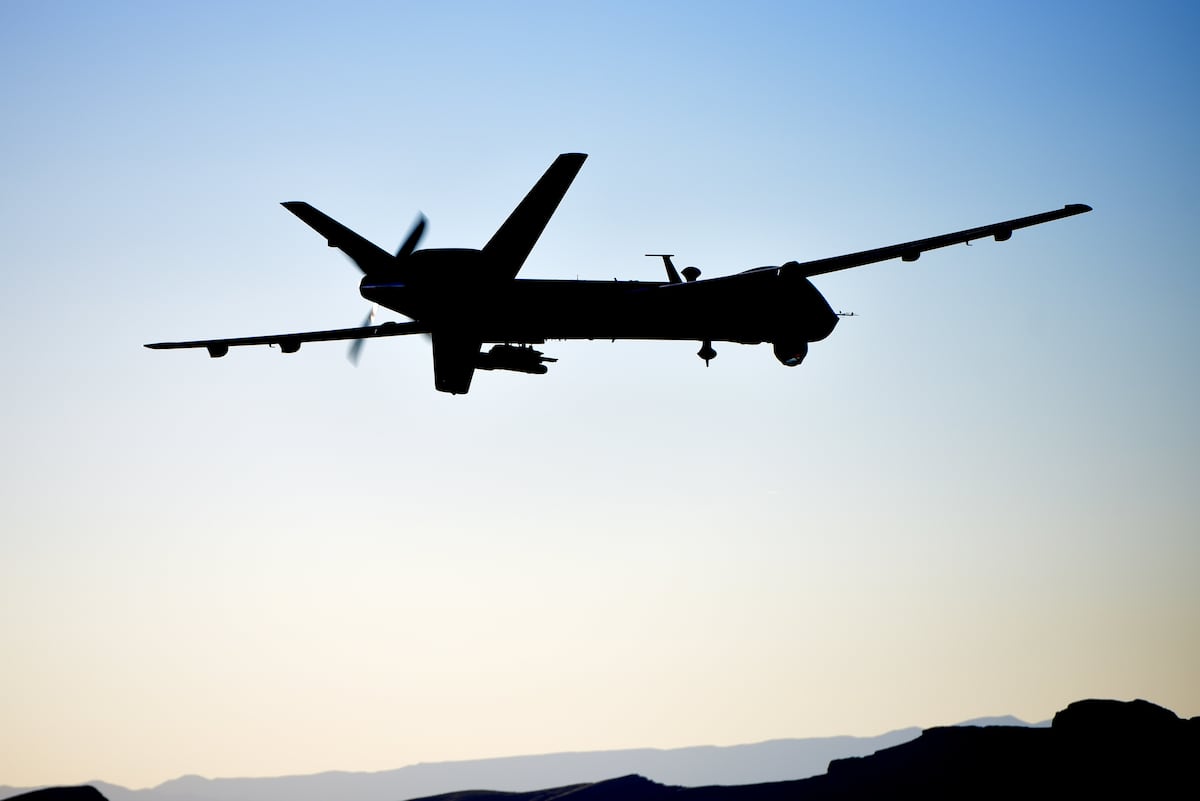

The U.S. Air Force’s MQ-9 Reaper fleet has fallen to roughly 135 aircraft as combat attrition from Operation Epic Fury cuts into the service’s most heavily used remotely piloted asset, the deputy chief of staff for plans and programs told senators Tuesday.
Lt. Gen. David Tabor told the Senate Armed Services Subcommittee on Airland that the fleet is “still able to fulfill our contract of 56 combat lines worldwide” despite the losses, and the service is seeking to backfill the inventory and field a cheaper, more expendable replacement. The 56 combat lines represent the intelligence, surveillance and reconnaissance orbits the Air Force maintains around the clock for combatant commanders worldwide.
Sen. Kevin Cramer, R-N.D., opened questioning at the Senate hearing by citing the long-standing 189-aircraft floor, leaving the current fleet roughly 54 aircraft short. He asked what the Air Force plans to do as the platform takes losses in the Middle East while remaining in heavy demand across other combatant commands.
RELATED
Tabor did not address the 189 figure directly but noted that attrition has “really demonstrated the value of the MQ-9.”
“We are concerned about how they’ve attrited, and we’re looking at options to buy back as many of the MQ-9As as we possibly can right now,” Tabor said. The Air Force is working with the Department of Defense to fund the buyback this fiscal year, he said.
The longer-term work, Tabor said, falls to A5/7, the Air Force’s strategy, integration and requirements directorate. He turned the question over to Maj. Gen. Christopher Niemi, military deputy for Air Force Futures and the White House’s nominee to serve as the service’s first chief modernization officer.
Niemi confirmed that he signed off on a requirements document for the next-generation platform on May 11, framing the successor as a deliberate departure from the Reaper platform, designed from the outset for the kind of contested airspace that resulted in the Epic Fury losses.
“We believe what is possible is to take advantage of modern manufacturing technologies so that we could buy something that is more flexible, lends itself more to open architecture, is more easily [produced] in mass numbers,” Niemi said. ”And then ultimately you could use [it] in a more attritable way.”
The cost driver, Niemi said, is the Reaper’s sensor suite. A current MQ-9 with a full sensor package can run “up to $50 million a copy,” he said. A modular successor would allow the Air Force to strip out high-end packages for operation in high-threat environments, driving the price down to a point where losing one, or many, is operationally and financially feasible.
Lt. Gen. Luke Cropsey, military deputy for Air Force acquisition, said the service’s intelligence, surveillance and reconnaissance and special operations acquisition team issued a request for information about a month ago. More than 50 companies responded.
“There is a burgeoning interest across the broader defense industrial base on what comes next,” Cropsey said.
The April 14 solicitation, titled “Attritable ISR Aircraft,” seeks “low-cost, fast-to-field, fast-to-deploy, airborne ISR mass to increase mission flexibility and mission surging,” according to a copy of the document.
The service is looking for a threshold range of 200 km (objective: 1,500 km) from launch and recovery to the collection area, and a threshold loiter time of four hours (objective: 20).
Industry “production must be able to scale within months,” the RFI states.
Those specs suggest a smaller, simpler aircraft than the MQ-9, one that trades the Reaper’s exquisite sensor suite and long combat radius for cost, speed of fielding and what Niemi called “affordable mass” in his opening statement.
The math has shifted to match the threat.
The MQ-9 has been the Air Force’s workhorse drone for surveillance and strike missions in U.S. Central Command for nearly two decades, but the aircraft was built for the uncontested skies of the post-9/11 counterterrorism era.
Its losses during Operation Epic Fury have exposed the vulnerability Air Force planners have long understood but never been compelled to fix. The service shelved an earlier MQ-9 replacement effort, MQ-X, in 2012, and a 2020 request for information produced market research but no acquisition program.
The May 11 requirements document and the April 14 RFI together represent the furthest the Air Force has gone toward replacing the Reaper in more than five years.
The search for an MQ-9 successor is intended to follow the Collaborative Combat Aircraft acquisition model, Niemi said, which surveyed industry broadly, narrowed the field down to two companies that are now delivering flying prototypes for testing, and treated open architecture and autonomous operation as design requirements from the outset.
Cropsey said the industry’s response has been strong.
“We have enough interest to really get some, I think, interesting proposals back,” he said.
Read the full article here