


Evaluated on strictly tactical terms, the Japanese surprise attack on Pearl Harbor, Hawaii on Dec. 7, 1941 has been praised for its precision and criticized for the importance of targets it neglected. The Japanese focused their effort against warships and aircraft, but overlooked fuel stores and a new fleet oiler, USS Neosho (AO-23). Although Neosho would be eliminated five months later — and even then, due to misidentification — its presence over those months kept the recuperating United States Navy operational in a desperate hour — and produced a Medal of Honor recipient amid its last fight.
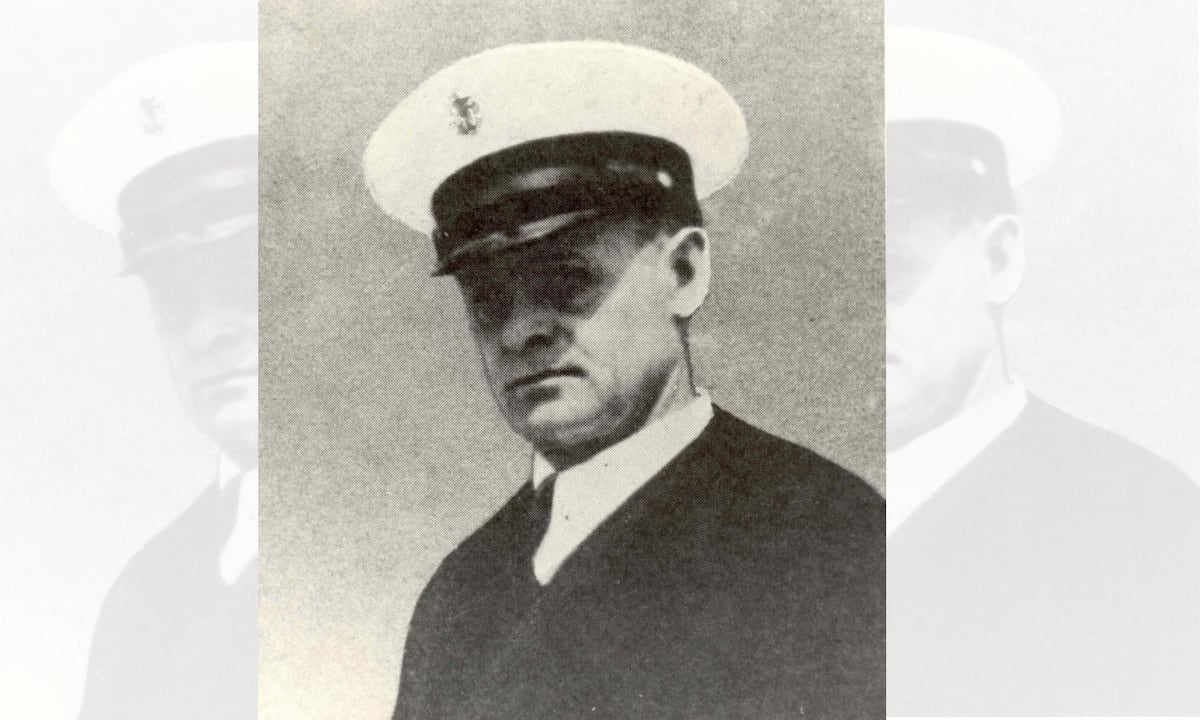
Oscar Verner Peterson was born Aug. 27, 1899 in Prentiss, Wisconsin, and swiftly grew into his chosen career, enlisting in the U.S. Navy on Dec. 8, 1920. By the end of 1941, he was Chief Water Tender (chief petty officer) aboard Neosho, which had just been commissioned in 1939.
“She simply was the kind of unglamorous workhorse without which a modern navy could not operate,” writes historian Robert C. Stern. “Excepting a few token defensive guns, no one would ever mistake her for a warship. But against all odds, not only did the Neosho have a combat career, she had an extraordinary one.”
Capable of carrying 146,000 barrels of fuel, the ship was delivering aviation gas at Ford Island on Dec. 6, 1941. The next morning saw it tied up in Battleship Row. And while the Japanese were targeting the battleship Maryland (BB-46), their bombs fell nearer to Neosho as it cast off its moorings.
Its three 3”-23 caliber anti-aircraft and one 5”-51 caliber gun were among the first to fire back against the enemy that December day.
Narrowly missing the Oklahoma, the Neosho backed its way into mid-channel and slipped into Southeast Loch. Three of the oiler’s crew were wounded by strafing, while its gunners claimed to have shot down a Japanese plane. Otherwise unscathed through the carnage, Neosho played an important role supporting the aircraft carriers that had likewise avoided the disaster at Pearl Harbor.
The fate that Neosho initially managed to avoid finally caught up during the Battle of the Coral Sea,however.
On May 1, 1942, Neosho fueled up carrier Yorktown (CV-5) for the coming fight. As the main carrier forces closed on each other, Rear Adm. Frank Jack Fletcher, commanding Lexington (CV-2) and Yorktown, ordered Neosho to withdraw south of his force, with destroyer Sims (DD-409) for escort.
Ironically, Neosho became involved in the battle by mistaken identity.
At 0722 hours on the 7th, it was spotted by two patrolling Nakajima B5N2s from the Japanese Shokaku, whose crews reported it to be an “aircraft carrier.”
Vice Adm. Chuichi Hara sent contingents from both of his flattops to dispose of that threat and in the ensuing action Neosho took seven dive bomber hits, with another eight near misses.
Even then, some crewmen manned the oiler’s anti-aircraft guns, setting fire to a Zuikaku D3A crewed by Petty Officer 2nd Class Shigeo Ishizuki and Petty Officer 3rd Class Kawagoe Masayoshi.
Judging his plane doomed, Ishizuki pulled up enough to drop his bomb and then crashed into Neosho’s No.4 gun, further spreading the fire. At the same time, USS Sims was hit by three bombs, one of which which caused a boiler explosion causing the destroyer to sink within minutes, taking all but 15 of its 250-man crew with it.
Neosho was turned into a floating conflagration, but its crew did all they could to save it, most notably Chief Water Tender Peterson, who led a repair party throughout the uneven encounter. As his citation describes:
“Lacking assistance because of injuries to the other members of his repair party and severely wounded himself, Peterson, with no concern for his own life, closed the bulkhead stop valves and in so doing received additional burns, which resulted in his death.”
In spite of third degree burns, Peterson’s determination in mechanically closing critical stream-line valves amid smoke and flames kept Neosho — and 123 of its crew — afloat until well after the battle.
Coral Sea ended in a tactical victory for the Japanese, seeing the sinking of Lexington, but a strategic win for the Americans, who sank the light carrier Shoho and, more important, drove back the Japanese attempt to seize Port Moresby in Papua New Guinea.
In its aftermath, the destroyer Henley (DD-391) rescued Sims’ 15 survivors and on May 11 it found Neosho, dead in the water with a 30-degree list and 21 of its crew dead. After evacuating its 123 surviving sailors — including Peterson — it finished off the valiant oiler with gunfire.
On the 13, Peterson died from the severe burns he had suffered during battle and was buried at sea.
In December 1942, Peterson’s wife, Lola, and his sons, Fred and Donald, received a letter announcing his award of the Medal of Honor. A memorial to him can be found in the “Tablets of the Missing” in the American Cemetery in Manila, Philippines.
On June 27, 2025, he was further memorialized when Secretary of Defense Pete Hegseth ordered the underway replenishment oiler Harvey Milk (AT-AO-206) renamed Oscar V. Peterson.
Read the full article here