

President Donald Trump fired rhetorical warning shots at several governments across the globe this week. Nations from Scandinavia to the Middle East found themselves in Trump’s crosshairs, as he also doubled down on his desire to assert U.S. dominance across the Western Hemisphere.
Trump seems intent on remaking the global order in the wake of the U.S. military raid on Venezuela and his subsequent declaration that Washington would “run” the South American nation.
RELATED
Hours after Operation Absolute Resolve — a mission that saw U.S. forces capture Venezuelan leader Nicolás Maduro and his wife, Cilia Flores, from their compound in Caracas — the White House posted a black-and-white photo of Trump with a caption that read, “No Games. FAFO.” The acronym stands for “f— around and find out.”
Trump’s first instinct “is always diplomacy,” White House spokeswoman Anna Kelly told Military Times, noting it’s the president’s “dealmaking expertise” that helped him end wars. But she underscored that Trump “always has a host of options at his disposal, and all of his actions have put America First while making the entire world safer.”
Here are the countries Trump has put on high alert.
Greenland
The United States has renewed its pursuit of Greenland, which the Trump administration deems vital for the protection of U.S. national security interests in the Arctic — specifically, to counter China and Russia. The White House said the president is considering “a range of options” to acquire the island, including the possible use of force.
Trump ramped up his rhetoric over Greenland on Friday, saying he would “like to make a deal the easy way, but if we don’t do it the easy way, we’re going to do it the hard way.”
Danish Prime Minister Mette Frederiksen proclaimed that a U.S. attack on Greenland, a self-governing territory within the Kingdom of Denmark, would spell the end of NATO. Trump’s approach to Greenland has also caused broader consternation among European allies.
Iran
Anti-government protests have erupted across Iran in recent weeks, fueled by crippling economic conditions and political discontent.
Trump has stopped short of endorsing regime change in Tehran, but has suggested the U.S. would intervene if Iranian authorities resort to egregious use of lethal force against demonstrators — as they have done in previous episodes of unrest in the country.
“If they start killing people, which they tend to do during their riots … we’re going to hit them very hard,” Trump said Thursday, adding that the Islamic Republic would “have to pay hell” for violent repression.
Iran’s Supreme Leader Ayatollah Ali Khamenei, in a speech broadcast on state TV Friday, vowed to “not back down,” and accused protesters of acting on behalf of Trump.
Mexico
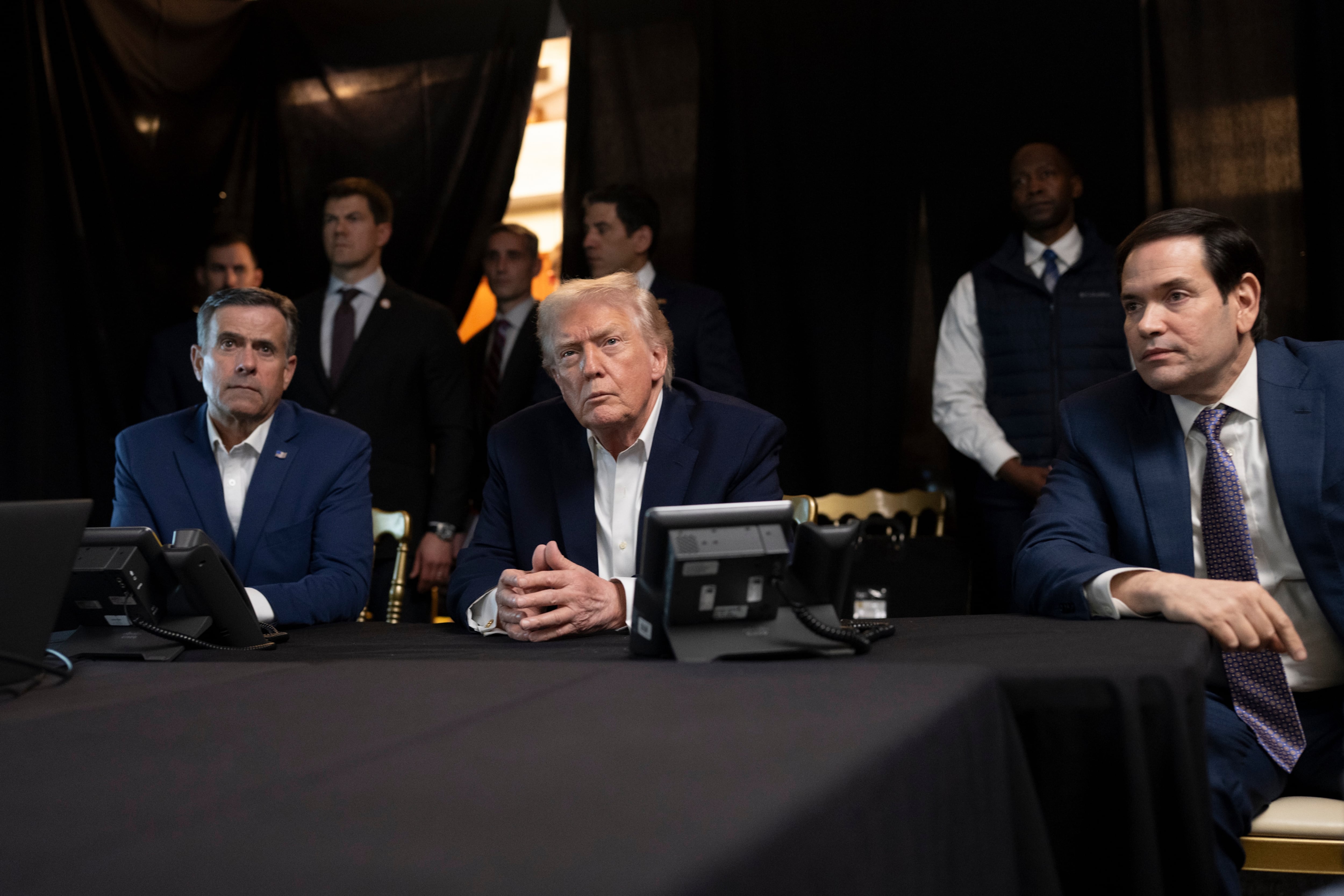
U.S. land strikes on Mexico targeting drug cartels could be imminent, according to Trump.
“We are going to now start hitting land with regard to the cartels,” Trump told Fox News on Thursday, framing the military campaign as his war on drugs.
He previously said that drugs are “pouring through Mexico” and indicated that the cartels are running the country, not President Claudia Sheinbaum.
Nigeria
Trump said he could authorize additional U.S. strikes on Islamic State militants in Nigeria if attacks on Christians continue unabated.
“I’d love to make it a one-time strike. … But if they continue to kill Christians, it will be a many-time strike,” Trump said Thursday.
Last month, Trump ordered lethal Christmas Day strikes, which he called “a Christmas present,” after a series of warnings that the U.S. military would go “guns-a-blazing” into Nigeria if the government continued to “allow the killing of Christians.”
The degree to which violence in Nigeria is primarily motivated by religion is disputed, however, with struggles over land and water rights — and general criminality — among the other factors at play.
Colombia
Tensions between the U.S. and Colombia showed signs of thawing Wednesday following a phone call between Trump and Colombian President Gustavo Petro.
Trump, in a post on Truth Social, wrote that his Colombian counterpart called “to explain the situation of drugs and other disagreements that we have had.” Trump said he “appreciated his call and tone,” and suggested that he invited Petro to meet at the White House “in the near future.”
The apparent rapprochement between the two countries came days after Trump told reporters an invasion of Colombia “sounds good to me,” and disparaged Petro as a “sick man” who “better watch his a–.”
Petro, who criticized the U.S. military operation to depose Maduro, said he would “take up arms” against the United States if it were to attack.
Venezuela
The president announced on Friday a “previously expected” second wave of attacks on Venezuela has been canceled, citing the South American nation’s cooperation with the United States.
“The U.S.A. and Venezuela are working well together, especially as it pertains to rebuilding, in a much bigger, better, and more modern form, their oil and gas infrastructure,” Trump wrote on Truth Social. “Because of this cooperation, I have cancelled the previously expected second Wave of Attacks, which looks like it will not be needed, however, all ships will stay in place for safety and security purposes.”
At a meeting with more than a dozen oil companies at the White House on Friday, Trump said Venezuela has “been very smart in the way they have dealt with us” after the U.S. ousted Maduro.
“That whole place could have been obliterated with one more strike and we didn’t want to do that.”
Tanya Noury is a reporter for Military Times and Defense News, with coverage focusing on the White House and Pentagon.
Read the full article here