

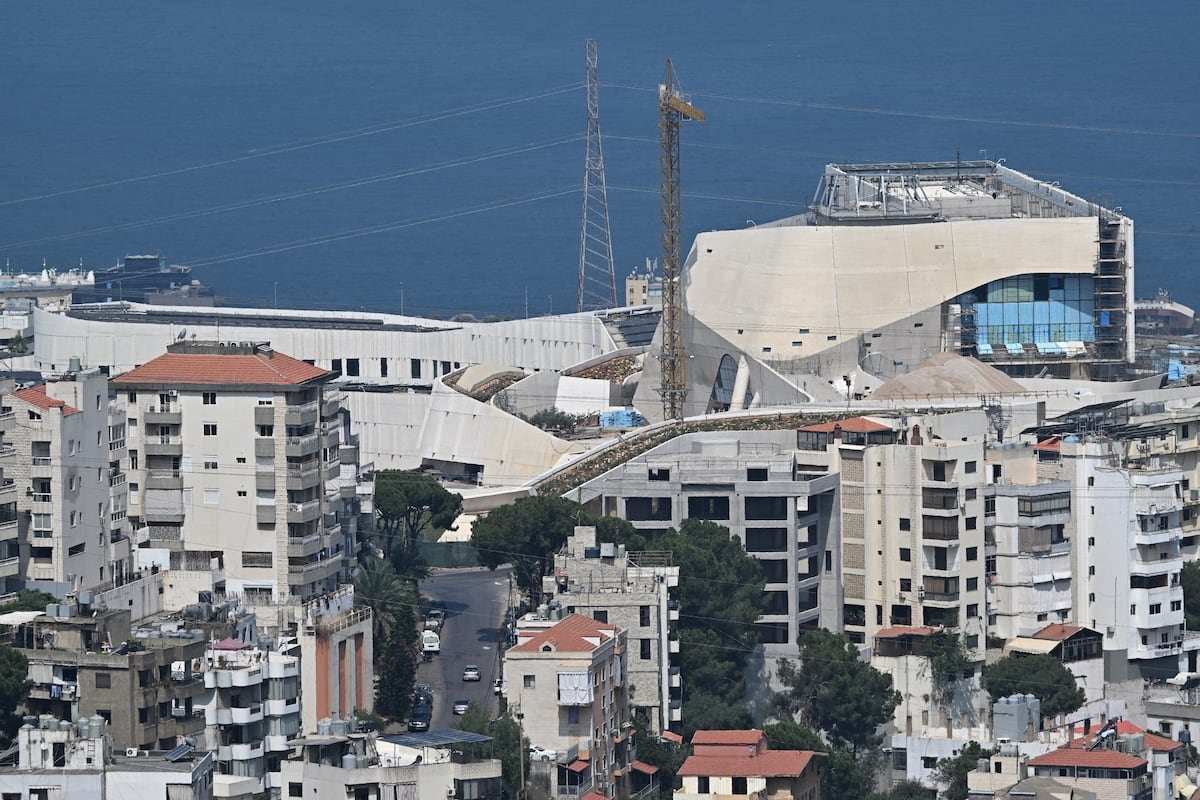

The United States has ordered nonessential personnel and their family members to leave its embassy in Beirut, a senior State Department official told Military Times on Monday, as Washington continues a massive military buildup in the Middle East.
The official, who spoke on the condition of anonymity to discuss sensitive information, said the drawdown is a “prudent” step to reduce the American footprint in the region while President Donald Trump mulls a strike on Iran.
“The Embassy remains operational with core staff in place. This is a temporary measure intended to ensure the safety of our personnel while maintaining our ability to operate and assist U.S. citizens.”
Embassies are often thinned when security threats in the region rise. Prior to Operation Midnight Hammer — the multipronged U.S. attack on three Iranian nuclear sites last June — the State Department withdrew nonessential personnel from posts in Bahrain, Iraq, Kuwait and Lebanon.
Beirut was the site of deep trauma for the U.S. a generation ago. In 1983, Hezbollah, an Iranian-backed proxy group, killed 220 Marines, 18 Navy sailors and three Army soldiers in a suicide bombing of the Marine barracks in the city.
Today, Lebanon remains the primary base of Hezbollah. The latest U.S. evacuation of embassy staff and their families from Beirut comes amid broader fears of expected retaliation against American targets by groups allied with Tehran, should Washington opt for military action.
The diplomatic winnowing coincides with the rapid expansion of American war-fighting assets in the region. Dozens of aircraft — including F-16 and F-35 jets — are now deployed, alongside two carrier strike groups — the USS Gerald R. Ford and USS Abraham Lincoln.
The Ford, the Navy’s largest aircraft carrier, arrived Monday at a key NATO base on the Greek island of Crete after redeploying from the Caribbean, according to video footage.
The mobilization represents the largest concentration of American firepower in the Middle East since the 2003 invasion of Iraq.
Special Envoy Steve Witkoff, Trump’s lead negotiator with Iran, told Fox News on Saturday that the president cannot understand why the Islamic Republic has not “capitulated” to America’s demands over its nuclear program in light of the massing of U.S. military might.
“I don’t want to use the word ‘frustrated’ … because [Trump] understands he’s got plenty of alternatives,” Witkoff said. “But he’s curious as to why they haven’t — I don’t want to use the word ‘capitulated,’ but why they haven’t capitulated?
“Why, under this sort of pressure, with the amount of sea power and naval power that we have over there, why they haven’t come to us and said, ‘We profess that we don’t want a weapon, so here’s what we’re prepared to do?”’ he questioned. “It’s hard to sort of get them to that place.”
American and Iranian officials are set to meet for a third round of nuclear talks in Geneva on Thursday — a session widely viewed as a final attempt to reach a compromise before Trump moves closer to military action.
Oman, which has served as an intermediary between the two sides, described the upcoming negotiations as “a positive push to go the extra mile towards finalizing the deal.”
Tanya Noury is a reporter for Military Times and Defense News, with coverage focusing on the White House and Pentagon.
Read the full article here