
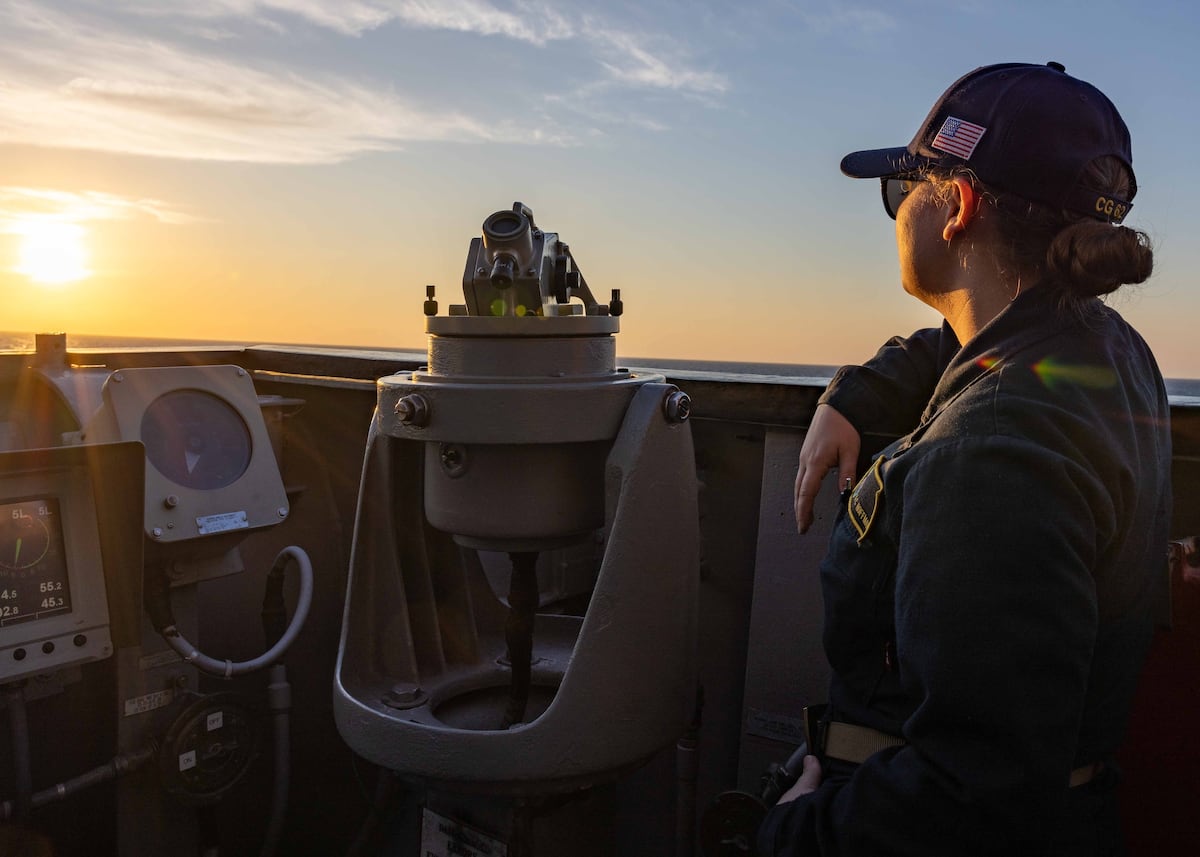

The U.S. Navy sent the last Ticonderoga-class cruiser homeported overseas back to the states, the sea service announced Wednesday.
The USS Robert Smalls will leave Yokosuka, Japan, for San Diego, California, and be replaced by the Arleigh Burke-class guided-missile destroyer USS Mustin.
“This move will be a permanent change of station for the crew and family members,” the Navy said.
The move, according to the service, is part of a scheduled rotation of forces in the Pacific.
The Smalls was most recently assigned to Carrier Strike Group Five in support of U.S. military operations in the Indo-Pacific region.
The cruiser, commissioned in 1989, was initially named the USS Chancellorsville, a nod to the city in which Confederate Gen. Robert E. Lee beat Union forces in one of the bloodiest battles during the Civil War.
RELATED
The Navy changed the cruiser’s name in 2023 to honor Robert Smalls, a Black Civil War hero who stole a Confederate steamer when he was a slave and delivered it to the Union navy. He became a free man and a U.S. Navy captain, and served five nonconsecutive terms in the U.S. House of Representatives for South Carolina.
There are only 10 Ticonderoga-class cruisers remaining in the Navy fleet as of April 23, 2025, according to the service, and the Smalls was the only one homeported overseas before it was announced it would leave the U.S. 7th Fleet area of responsibility.
The Mustin was commissioned on July 26, 2003, and assigned to Destroyer Squadron 23, based in San Diego, California.
The Mustin shifted homeports in 2006 and was forward deployed to Destroyer Squadron 15, the Navy’s largest destroyer squadron that operates out of the U.S. 7th Fleet, according to the Navy.
Starting in 1980, the Navy built 27 Ticonderoga-class cruisers, which were the first ships able to wield the AEGIS Combat System, an advanced weapons platform that utilizes radar to detect, track and fire at targets.
Riley Ceder is a reporter at Military Times, where he covers breaking news, criminal justice, investigations, and cyber. He previously worked as an investigative practicum student at The Washington Post, where he contributed to the Abused by the Badge investigation.
Read the full article here