

The U.S. Navy announced a new chapter of unmanned surface vessel acquisition that seeks to accelerate development of autonomous capabilities and ditch its previous program.
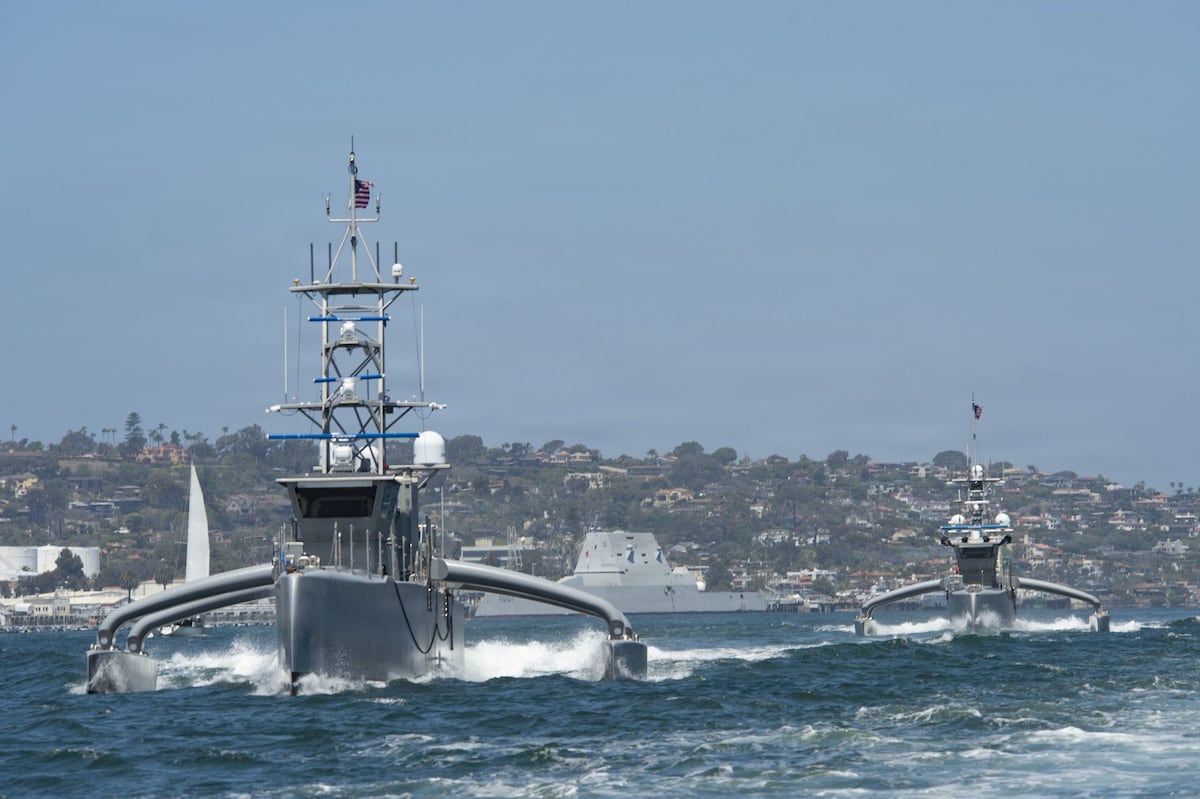
The service commenced the Medium Unmanned Surface Vessel Family of Systems program on Thursday, opening up solicitations for a specific class of boat touted as an integral part of the service’s Golden Fleet initiative.
“Our goal is to create a regular and recurring marketplace, not just for the MUSV, but for other classes of vessels as well, over time, designed to match the growing demand for unmanned systems across a range of missions,” said Rebecca Gassler, portfolio acquisition executive for the U.S. Navy’s robotic and autonomous systems.
Gassler, who spoke with reporters during a virtual Thursday media roundtable, said the marketplace was seeking production-ready, mission-capable vessels that were aligned with Chief of Naval Operations Adm. Daryl Caudle’s containerized capability campaign plan.
The CNO announced the plan during McAleese Defense Programs conference last week, detailing a vision in which modular payloads — or transportable containers housing defense capabilities such as drones and weapons — can be deployed to any region in the world.
RELATED
The MUSV program was focused on demonstrated performance at sea, and not on the rigmarole of development, Gassler outlined.
The solicitation, which closes April 17, will analyze a company’s business plan, manufacturing plan, test plan and technical design.
From there, chosen companies and their medium unmanned surface vessels will complete an on-water test, which will be conducted by the end of the fiscal year.
After the Navy undergoes initial testing of these vessels, the service will offer a fixed price payment to companies that successfully complete the on-water test and move into production or a leasing agreement, Gassler said.
Speed and efficiency were front of mind.
There wouldn’t be a year of prototyping and development, according to Gassler. The Navy would look at a company’s business plan, manufacturing capabilities, do a test, and then it would be “off to the races” for production.
The first of the production vessel was expected be delivered in fiscal 2027.
As for the closure of MASC, Gassler said that the program was tailored toward a specific mission for a specific ask and quantity from the fleet, whereas the Navy had a much wider variety of requirements and mission types for the MUSVs in the Golden Fleet.
Announced in December 2025, the Golden Fleet will see the construction of new Trump-class battleships, which will reportedly be triple the size of an Arleigh Burke-class destroyer.
Navy Secretary John Phelan applauded the new marketplace on social media Thursday.
“This new approach will leverage private investment and accelerate the delivery of real capabilities to the Fleet,” Phelan said in an X post. “We will reward the companies who are able to deliver capability at the speed of relevance.”
The Navy announced the Modular Attack Surface Craft, or MASC, program on July 28, 2025.
The program solicited the development of unmanned surface vehicles that were “non-exquisite” and could be constructed and maintained easily.
The program asked for USVs that were capable of carrying large containerized payloads that could accommodate a similar weight to the Navy’s anti-ballistic missile system, the Mark 70 Mod 1 Payload Delivery System.
“The One Big Beautiful Bill Act contained nearly $5 [billion] for US Navy unmanned programs, including $2.1B for medium unmanned surface vessels,” a Navy official told Military Times in an emailed statement. “Unmanned vessels will be integral to the Navy’s Golden Fleet and Hedge Strategy.”
Riley Ceder is a reporter at Military Times, where he covers breaking news, criminal justice, investigations, and cyber. He previously worked as an investigative practicum student at The Washington Post, where he contributed to the Abused by the Badge investigation.
Read the full article here