

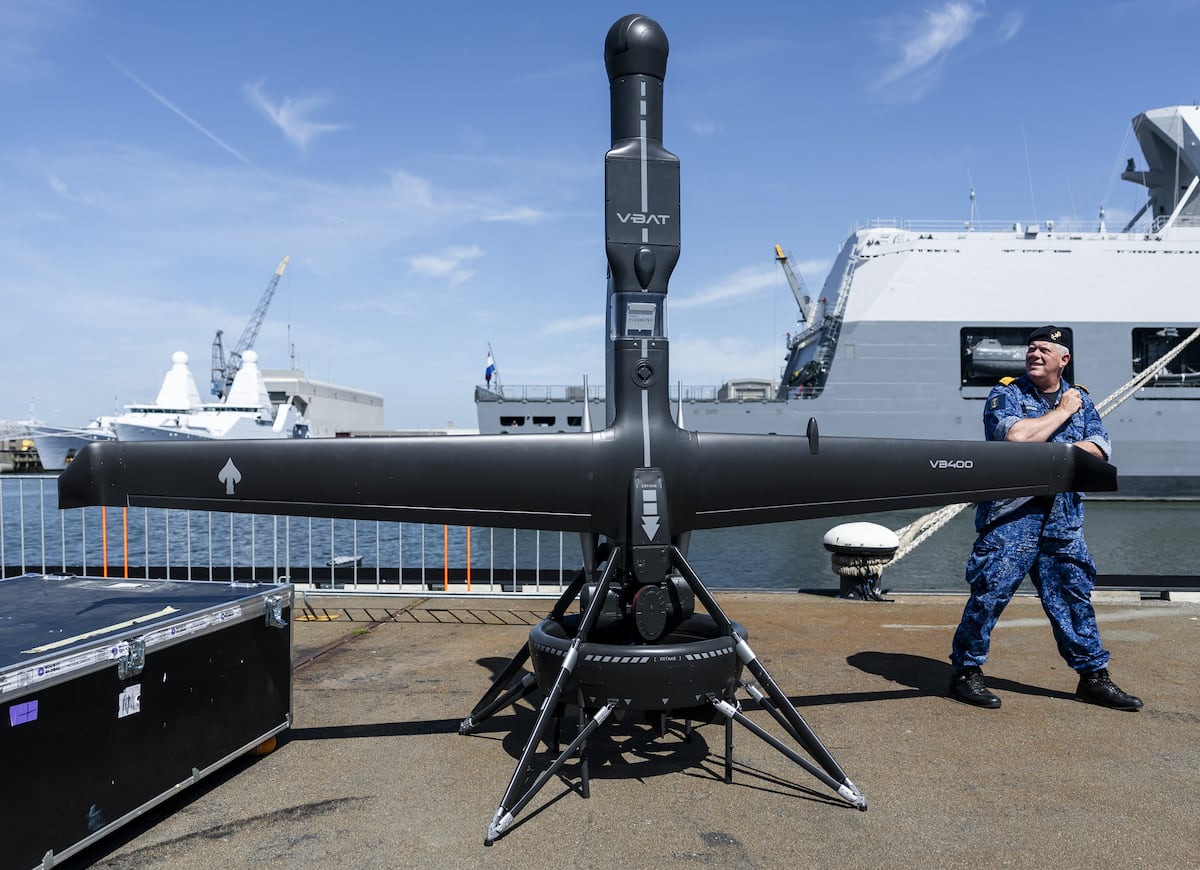

PARIS — Western navies are betting on modularity to keep their fleets relevant in the face of fast-changing technology, according to naval commanders gathered in Paris last week, with an ability to switch out equipment that the Dutch navy chief likened to clipping Lego bricks onto vessels.
New naval designs increasingly incorporate containerized payloads, and the commanders of the United States, Italian, Dutch and British navies cited advantages including mission flexibility, quickly getting firepower on the water, and at-sea replenishment.
Italy’s new Thaon di Revel-class patrol frigates have been designed to carry containerized mission modules, while the Netherlands announced a class of multi-role support ships mounting containers loaded with anything from air-defense missiles to electronic-warfare kit or assault drones. The United States Navy has said its new frigate will be fitted with containerized mission packages.
“All our future ships, they will be specifically designed for this kind of capability,” said Adm. Giuseppe Berutti Bergotto, chief of staff of the Italian Navy, speaking at the Paris Naval Conference. “The primary role of the ship will be the same, but the ship needs to have this capability to be ready to attack different missions.”
The modularity of the patrol frigate “was a great idea” that the Italian Navy is now trying to apply to all its construction, according to Berutti Bergotto. He said the navy has also experimented with fitting different containers with different payloads on the deck of a commercial vessel.
“If you look at modularity, it’s like Lego, building blocks are already there, you just need to put them together,” said Vice Adm. Harold Liebregs, the commander of the Royal Netherlands Navy, on the sidelines of the conference. “But keep it simple. Don’t over-integrate.”
The Netherlands has said its modular support vessels will be able to mount a containerized version of the Barak ER surface-to-air interceptor from Israel Aerospace Industries, as well as the company’s Harop long-range loitering munitions.
Liebregs said introducing modularity is sometimes “easier said than done, because not every Lego block now is good enough,” but modules such as air-defense missile systems are available and ready to be plugged in. He said navies have to accept they will have to learn along the way, “so just start somewhere as soon as possible.”
The Dutch navy needs to be ready for war by 2028, and “one of my main challenges is to bring more firepower to sea,” Liebregs said. The multi-role support vessel concept is one possible solution, and fitting such a ship with a container full of Barak missiles would quickly provide some “very capable air-defense capability,” allowing for mass and dispersed operations.
Such ships would have reduced crews of six to eight sailors, and roles might also include escorting Russian vessels in the North Sea, “saving a lot of very expensive warships,” according to the Dutch commander.
“It’s an affordable way to augment our fleet,” Liebregs said. “These kinds of ships are very adaptable, and it fits very well to short-cycled innovation, the thing we very much need.”
The United Kingdom’s Royal Navy is running its own modular mission-system program, and is now trialing what it calls “mission pods” that were produced in the autumn of last year, said Gen. Gwyn Jenkins, the United Kingdom’s First Sea Lord and chief of naval staff. He said standardization of data and power cable connections is key.
“We’re all on this journey, I think,” Jenkins said. “As long as you’ve got commonality across the system, then we can position those mission pods around our different naval bases with allies, give ourselves the ability to come back in and change pods, go back out to sea in any format, replenish at sea with different pods.”
Modularity will allow naval vessels to adapt to future threats as well as new technology, such as the on-board power required for future direct-energy weapons, Berutti Bergotto said. He said navies also need to be able to make changes during ship construction to take into account emerging threats and remain relevant at sea.
He cited his command of the Horizon-class destroyer Andrea Doria, which was commissioned in 2010 with cathode-ray tube monitors because that was the available technology six years earlier.
“When you commission the ship, this ship lasts for 20 years, pretty much,” the Italian admiral said. “You cannot have, after one year, an old ship.”
The U.S. attempted to include modularity in the Littoral Combat Ship program but failed to predict the complexity of building effective modules, and under-invested in that area, according to U.S. Chief of Naval Operations Adm. Daryl Caudle.
“We’ve learned from that mistake,” Caudle said. “Going forward with our small surface combatant, we’re going to put more energy into this from the acquisition side, the research and development, and how to containerize payloads that we need” to make that ship type effective.
“When you put that ship to sea with modular force packages, things that can be containerized, from ordnance to unmanned systems to towed arrays — the sky’s the limit on what you can modularize there on that platform,” Caudle said. “Then we can build them quickly, fill them.”
Modularity will allow the U.S. Navy to tailor the “high-low mix” to create force packages that might be more suitable to deal with a threat than a carrier strike group or amphibious strike group, according to Caudle.
Caudle said modularity goes beyond payloads, and can also boost U.S. shipbuilding capacity, with the admiral citing large surface ships such as liquid natural gas tankers that are built in modules. The U.S. has historically built its combat ships as a single unit, with the Virginia-class submarines the first move into modularity, according to the sea service chief.
“You’re going to see us extend that methodology to all of our ships going forward,” Caudle said. “What that does is allow more shipyards to enter the actual shipbuilding game and add capacity to an oversubscribed yard structure by tailoring what they can do to add value to how we build our ships and deliver them quickly.”
Rudy Ruitenberg is a Europe correspondent for Defense News. He started his career at Bloomberg News and has experience reporting on technology, commodity markets and politics.
Read the full article here