

Editor’s note: This story originally appeared on Laser Wars, a newsletter about military laser weapons and other futuristic defense technology. Subscribe here.
The U.S. Navy spent at least six months resurrecting a high-energy laser weapon that previously graced the bow of a warship for a new military exercise last year, the service recently revealed.
The Navy’s Directed Energy Systems Integration Laboratory, or DESIL, a Naval Base Ventura County, California, facility that evaluates laser weapons in a maritime environment, “ramped up efforts to restore critical functions” to the service’s “one-of-a-kind” 150 kW Solid State Laser Technology Maturation (SSL-TM) demonstrator starting in early March 2025, according to recently published ‘year in review’ bulletin from Naval Sea Systems Command.
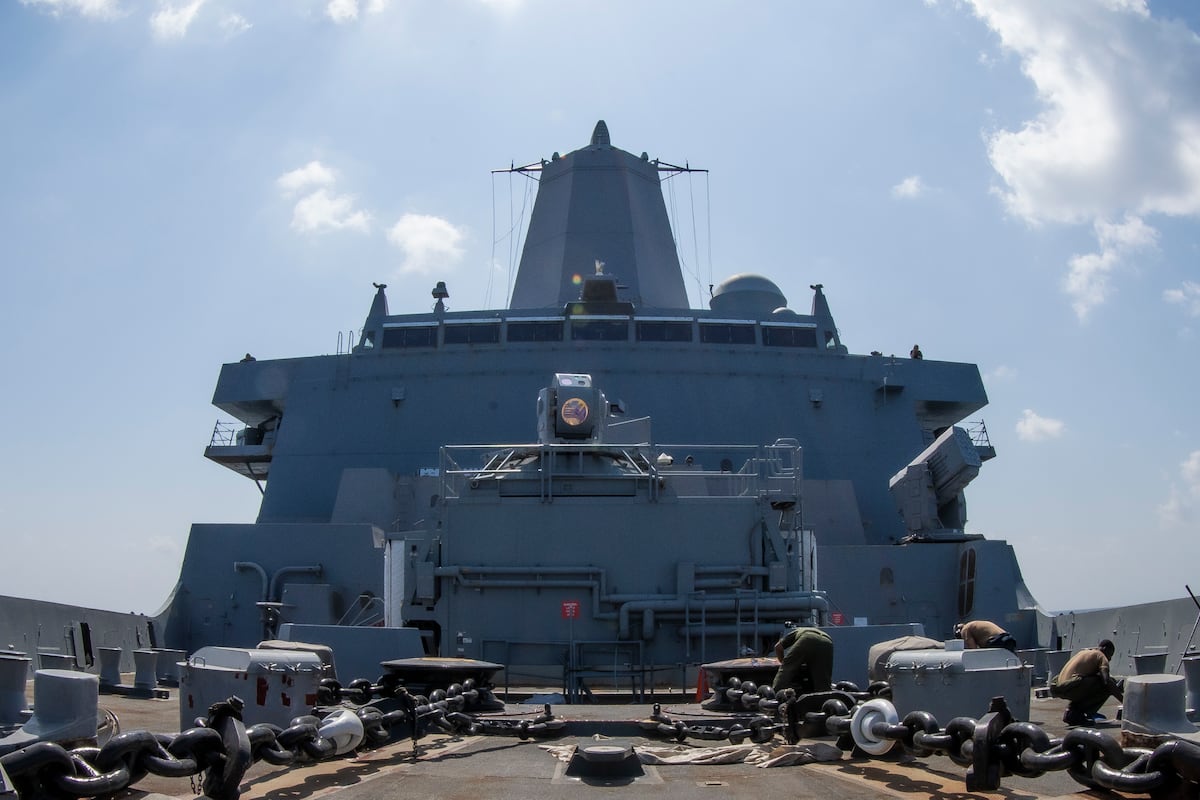
Initiated in 2012 and officially known as the Laser Weapon System Demonstrator Mk 2 Mod 0, the SSL-TM demonstrator was originally installed aboard the San Antonio-class amphibious transport dock USS Portland in 2019.
The system, described as the successor to the 30 kW AN/SEQ-3 Laser Weapon System — also known as the XN-1 LaWS — that was mounted on the Austin-class amphibious transport dock USS Ponce in 2014, was designed to “provide a new capability to the Fleet to address known capability gaps against asymmetric threats,” such as now-ubiquitous aerial drones and small boats laden with explosives, as well as “inform future acquisition strategies, system designs integration architectures and fielding plans for laser weapon systems,” according to Navy budget documents.
The SSL-TM demonstrator appears to have performed as advertised. The system successfully destroyed a drone target during at-sea testing in the Gulf of Aden in May 2020 — an engagement that yielded one of the most vivid representations of a real-world laser weapon in action to date — and neutralized a small surface target during additional testing in December 2021.
But while prime contractor Northrop Grumman had specifically designed the SSL-TM demonstrator for installation “with minimal modification or additional costs” aboard the Navy’s Arleigh Burke-class guided missile destroyers, the service initiated the system’s deinstallation from the Portland in fiscal year 2023 after spending nearly $50 million on the effort, the budget documents say. The Defense Department’s final report on the initiative has not yet been made public.
Following the deinstallation, the SSL-TM demonstrator was presumably mothballed until the Office of the Under Secretary of Defense for Research and Engineering requested the laser weapon “play a role” in the Pentagon’s new Crimson Dragon military exercise the following September, the NAVSEA bulletin says.
Described as a weeklong, multi-unit DESIL test event, Crimson Dragon convened 20 defense contractors “in a simulated combat environment” to test the effectiveness of their drones, counter-drone systems and sensors “in scenarios that simulated military base defense, long-range fires and integrated [ballistic missile defense],” according to the bulletin.
The SSL-TM demonstrator successfully shot down four drone targets during the exercise, the bulletin says.
While it’s unclear which scenarios the SSL-TM demonstrator participated in during Crimson Dragon, an annual assessment of U.S. military weapon systems from the Pentagon’s Director, Operational Test & Evaluation released on March 16 states that part of the exercise “focused on the sea point of departure defense venues against all-domain maritime air-and-sea threats,” which suggests the system may have provided air defense for a simulated port or staging area where troops and equipment embark onto ships.
But beyond these brief mentions in recent U.S. military publications, no additional information is available regarding the current status of the SSL-TM demonstrator, its performance during Crimson Dragon and the Navy’s future plans for the system. NAVSEA, OUSD(R&E) and the Office of Naval Research did not respond to requests for more details from Laser Wars.
Without more context, it’s difficult to infer where the return of the SSL-TM demonstrator fits into the U.S. military’s expanding directed energy ambitions.
The Pentagon has not indicated whether OUSD(R&E)’s request was driven by the urgency of real-world threats — the demonstrator was first tested in the very waters where Iran-backed Houthi rebels in Yemen had spent more than a year targeting U.S. warships and commercial shipping — or simply an opportunistic use of a capable system sitting in storage.
But the system’s restoration for Crimson Dragon potentially points to a broader challenge: despite years of testing and high-profile demonstrations, relatively few high-energy laser weapons are actually available for the kind of realistic, large-scale exercises needed to refine tactics and validate how these weapons are used in combat.
Indeed, it’s not like the Pentagon has bunch of spare laser weapons floating around to play with.
The U.S. Army’s four 50 kW Directed Energy Maneuver-Short Range Air Defense (DE M-SHORAD) systems have been completely demilitarized, while the service’s Army Multi-Purpose High Energy Laser (AMP-HEL) systems are preoccupied downing drones on the U.S.-Mexico border.
The Marine Corps returned its five Compact Laser Weapon System (CLaWS) to Boeing. The Navy’s AN/SEQ-4 Optical Dazzling Interdictor, Navy (ODIN) laser weapons are all installed aboard active warships at sea; meanwhile, the service’s 60 kW High Energy Laser with Integrated Optical Dazzler and Surveillance (HELIOS) system has had a challenging year on its own.
As a result, it appears that previously retired prototypes that might otherwise remain museum pieces are being called back into service to keep the U.S. military’s counter-drone experimentation moving forward.
The Pentagon may be racing to field laser weapons at scale, but for now it’s still relying on yesterday’s prototypes to figure out how they’ll actually fight tomorrow’s wars.
Read the full article here