
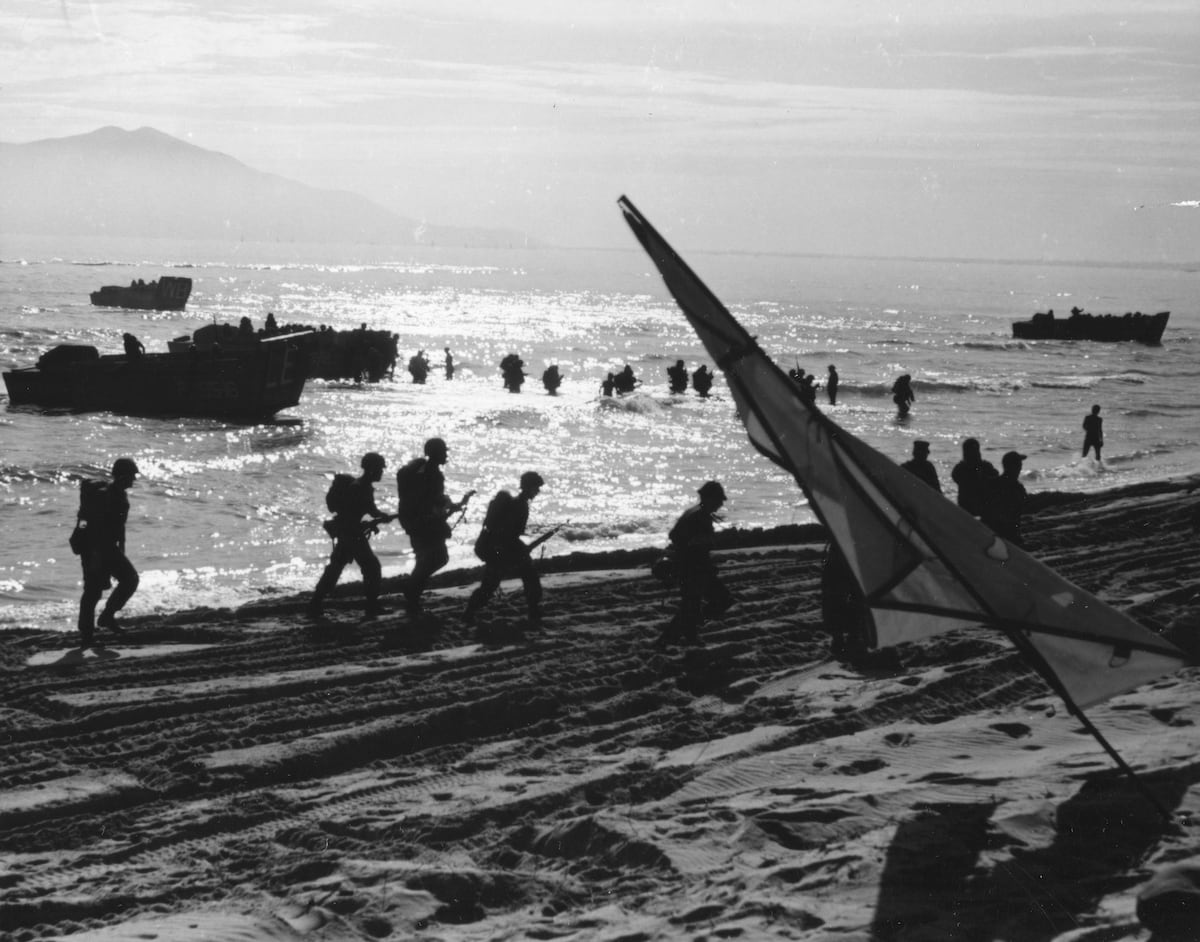

On March 8, 1965, 3,500 Marines of the 9th Marine Expeditionary Brigade — the first combat troops in Vietnam — waded ashore to the coastal city of Da Nang.
Unlike their forefathers, who were met with lethal sprays of machine guns and shells on the shores of the Pacific and Europe during World War II, these Marines were, almost comically, met by the mayor of Da Nang with girls placing wreaths around the Marines’ necks. Four American soldiers met them with a large sign stating: “Welcome, Gallant Marines.”
“Garlanded like ancient heroes, they then marched off to seize Hill 327, which turned out to be occupied only by rock apes — gorillas instead of guerrillas, as the joke went — who did not contest the intrusion of their upright and heavily armed cousins,” writes the Council on Foreign Relations.
While the U.S. had been involved in Vietnam for over a decade, with the U. S. Military Assistance Advisory Group existing in Vietnam as early as 1950, the arrival of the 9th Marine Expeditionary Brigade historically marks the Americanization of the Vietnam War.
Many in the upper echelons of American policymaking welcomed the landings. However, Maxwell Taylor, the U.S. ambassador to Vietnam at the time and a former chairman of the Joint Chiefs of Staff, expressed strong reservations. He predicted that it would be difficult to “hold the line” on further force commitments.
His fears would prove accurate.
By the end of 1965, 185,000 U.S. troops were in Vietnam. Less than three years later, the city that welcomed the Americans with handshakes and leis had become the host to high-level U.S. and South Vietnamese operations, including the headquarters of I Corps, the military zone encompassing South Vietnam’s northern provinces.
March of Folly
From the moment he was sworn into the presidency on Nov. 22, 1963, Lyndon B. Johnson was hardened to the notion that he was not going to be the first American president to lose a war, according to Pulitzer Prize-winning historian Barbara Tuchman in her book “The March of Folly”.
“Johnson’s idea was to fight and negotiate simultaneously,” she wrote. “The difficulty was that the limited war aim … was unachievable by limited war. The North had no intention of ever conceding a non-Communist South, and since such a concession could have been forced upon them only by military victory, and since such a victory was unattainable by the United States short of total war and invasion, which it was unwilling to undertake, the American war aim was therefore foreclosed.
“If this was recognized by some, it was not acted upon because no one was prepared to admit American failure. Activists could believe the bombing might succeed; doubters could vaguely hope some solution would turn up.”
As Johnson chose to fight and negotiate simultaneously, Operation Rolling Thunder began in earnest. The soon-to-be frequently interrupted bombing campaign had begun just prior to the sustained American ground campaign. The operation, which began on Feb. 24, 1965, had initially begun as a diplomatic signal to impress the North Vietnamese of America’s determination and serve as a warning that the violence would continue to escalate unless Ho Chi Minh “blinked.”
According to the Air Force Historical Division, Gen. Curtis LeMay argued that “military targets, rather than the enemy’s resolve, should be attacked and that the blows should be rapid and sharp.” When that outcome failed to arise after the first several weeks in March 1965, “the purpose of the campaign began to change.”
Throughout the next decade, more than 2.6 million U.S. servicemen and women eventually rotated through Vietnam. More than 58,000 of them died there, according to the Council on Foreign Relations.
Now, with President Donald Trump weighing his next steps in the war against Iran and thousands of soldiers from the U.S. Army’s elite 82nd Airborne Division arriving in the Middle East, certain parallels have begun to emerge between the opening days of the wars with Vietnam and Iran.
Operation Epic Fury
Since Operation Epic Fury, a joint undertaking by U.S. and Israeli militaries against the Islamic Republic that began on Feb. 28, over 11,000 targets have been struck.
“Targetry never makes up for a lack of strategy,” Gen. Jim Mattis, who served as Trump’s first defense secretary, cautioned in a recent interview. “By that I mean 15,000 targets have been hit. There have been significant military successes. But they are not matched by strategic outcomes”
Now, according to the Washington Post, the Pentagon is putting together plans for weeks of ground operations in Iran as U.S. forces amass in the region.
Citing multiple U.S. officials, the Post report suggested ground operations could involve both conventional infantry and special operations elements, but would not yet rise to the level of a full-scale invasion.
“It’s the job of the Pentagon to make preparations in order to give the commander in chief maximum optionality,” White House Press Secretary Karoline Leavitt said in a statement provided to Military Times. “It does not mean the president has made a decision.”
The Post’s report comes as U.S. military assets continue to flood the region. On Friday, U.S. Marines and sailors assigned to the Tripoli Amphibious Ready Group arrived in U.S. Central Command waters.
The Pentagon has also confirmed elements from the 82nd Airborne Division headquarters and a brigade combat team are deploying to the Middle East. Based out of Fort Bragg, North Carolina, the 82nd acts as the Army’s rapid-response force and is often among the first units sent to respond to emerging crises.
The report also comes on the heels of an Iranian missile and drone attack on Friday that injured a dozen U.S. service members at Prince Sultan Airbase in Saudi Arabia. Two of the 12 injuries are considered to be serious.
Thirteen service members have been killed in action and nearly 300 wounded during Operation Epic Fury, a joint undertaking by U.S. and Israeli militaries against the Islamic Republic that began on Feb. 28.
The majority of the wounded have since returned to duty, according to U.S. Central Command.
Jon Simkins contributed to this report.
Claire Barrett is an editor and military history correspondent for Military Times. She is also a World War II researcher with an unparalleled affinity for Sir Winston Churchill and Michigan football.
Read the full article here