
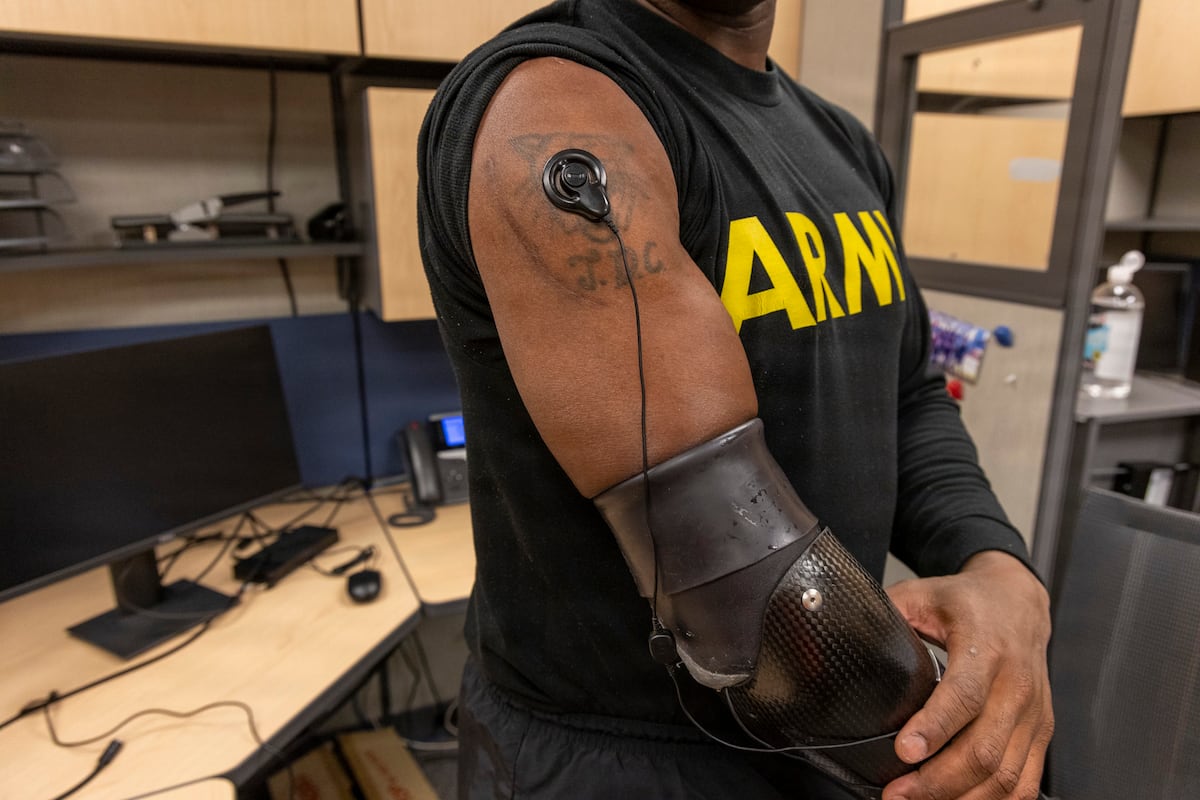

A U.S. soldier participating in a clinical trial at Walter Reed National Military Medical Center is testing a neural-enabled prosthetic arm designed to restore the sense of touch through nerve stimulation, the Maryland hospital recently announced.
The concept for the device originated with Drs. Ranu Jung and James Abbas of the University of Arkansas, who are conducting a study and contacted Walter Reed to participate as a second site.
“We created this prosthetic system to allow someone who uses a motorized prosthesis to feel what they are touching,” Abbas said in a release last month. “When someone has a standard motorized prosthesis, when the hand closes and touches something, they don’t feel it.”
The participant, described in the release as a soldier with an amputation below the elbow, typically uses a standard prosthetic with no sensation. After volunteering to test the sensory hand, the soldier described what changes when touch is returned.
“The new [prosthetic] gives me a ‘feeling sensation’ when I grab an object,” the soldier said. “I don’t need to look at an object when I pick it up, because I know it’s there. If I reach over to grab a pillow, the electrodes in the fingertips of the hand make it so that I have the sensation of holding something.”
Dr. Paul Pasquina, chief of the Department of Rehabilitation at Walter Reed, said troops’ experience with limb loss during the wars in Iraq and Afghanistan helped sharpen the need for better upper-limb prosthetics.
Combat trauma produces a higher percentage of upper-limb loss and multiple limb loss compared with disease-based amputations, which more often affect the lower limbs, Pasquina said in an interview with Military Times.
That gap, Pasquina said, also helped drive the Defense Department’s investment. He described early engagement with the Defense Advanced Research Projects Agency, including visits with wounded service members to better understand the limits of existing prosthetics.
Those conversations helped spur what became a multidisciplinary effort that brought together engineers, neuroscientists and clinicians to push both robotics and the human-machine interface forward, Pasquina said.
One of the biggest remaining limitations, he said, is sensory feedback, as there’s no prostheses available that provides such feedback.
Without sensation, users must rely on constant visual attention.
“If you have to look at everything that you’re picking up, your concentration needs to be on that thing you’re picking up,” Pasquina said. “It distracts you from other activities.”
“We cannot underestimate the importance of touch,” he added, citing the example of holding a child’s hand and knowing it is secure — moments that become far more complicated without sensation.
The trial aims to address that gap through an implanted interface paired with an advanced prosthetic hand. To enable sensation, the participant underwent surgery in which electrodes were implanted in their upper-arm nerves.
On the prosthetic itself, sensors in the fingertips connect to a box embedded in the forearm, described as an implant-hand interface that communicates with an implanted neurostimulator. When the soldier grasps an object, the system sends neural signals intended to re-create the feeling of touch, the release said.
The participant has tested the arm for more than a year and said it feels closer to a natural limb than any prosthetic used before.
The work presents challenges on both the surgical and engineering sides, according to Pasquina.
“These are tiny, tiny, fine wires that need to be implanted,” he said, describing the difficulty of placing electrodes near nerves while keeping the interface stable over time.
After implantation, the system must be calibrated, a process that relies heavily on participant feedback as engineers adjust stimulation frequency, intensity and duration to produce usable sensation.
Michelle Nordstrom, a research occupational therapist in the Department of Physical Medicine and Rehabilitation, said sensation restored through stimulation is not identical to natural touch, but it provides critical information users otherwise lack.
The added feedback can significantly reduce the mental effort required to use a myoelectric prosthesis, Nordstrom told Military Times. She described clinical testing in which participants struggled with certain tasks when stimulation was turned off. Examples include picking up a penny or maintaining a grip on a zipper pull.
“Once we turn the stimulation on,” she said, “they’re able to pick up that penny. They’re able to grab a hold of that zipper and maintain it.”
Restored sensation can increase confidence in everyday situations, from holding a drink in public to walking a dog using a prosthetic hand, Abbas, one of the device’s developers, told Military Times. He also noted the potential benefit for people with bilateral limb loss, particularly those injured by blasts, who lack an intact limb to compensate for sensory gaps.
Three of the seven participants in the study are connected to the military community, according to Nordstrom. She said the Walter Reed participant remains active in the Army, and two additional participants are veterans.
Trial participants commit to major surgery and years of testing without guarantees of success. That sense of service often resonates strongly with service members, even after injury, Abbas said.
“There are uncertainties, and we are asking a lot of the participants,” he said.
The study remains ongoing and is expected to move into a larger clinical trial. The device is not commercially available.
One of the biggest hurdles for widespread access is the economics of commercialization for relatively small patient populations, Pasquina said.
Further, insurance limitations in civilian settings can further restrict access to advanced prosthetics, a contrast to military care systems, Nordstrom noted.
Even after those limitations, prosthetic use remains a personal choice, Nordstrom said.
“There’s nothing wrong with someone choosing not to use a prosthetic device.”
Read the full article here