


In 1943 Fred Huntington, Jr. decided he’d rather make bullets than take over his father’s laundry in California. Just out of high school, he was swaging .22 lead cores in Vickery dies and jacketing them with spent rimfire cases. He peddled enough to cover expenses. But soon a more profitable idea came to mind: making dies.
Grosvenor Wotkyns, a shooter credited with designing the .22 Hornet, bought a set of Fred’s dies. “They need a name,” he said, and suggested “Rock Chuck Bullet Swage,” a nod to the West’s rock-slide-dwelling yellow-bellied marmot. That moniker was a mouthful, but condensed to RCBS, it suited Fred.
Soon the young man developed what he called the .243 Rockchucker wildcat on the .257 Roberts case, bumping shoulder angle from 21 to 32 degrees. It must have seemed an odd change. Why .243? Bullets abounded for the Roberts, and the .250/3000 Charles Newton had developed for Savage in 1913. Still, in 1953, Field & Stream shooting editor and wildcatter Warren Page wrote R.T. Davis at MGS Bullets to say he liked the Rockchucker and wouldn’t be surprised if sometime there were a commercial cartridge using a .243 bullet.

Two years later, Remington announced its .244 — Fred’s Rockchucker with a gentler 26-degree shoulder. At the same time the Page Pooper, developed with help from Mike Walker on the .308 case, emerged as the prototype for the .243 Winchester, a ballistic twin also introduced in 1955. Naturally, the .243’s 2.045-inch case fit short rifle actions for the up-and-coming .308. The .244’s case measured 2.233 inches — as did that of its .257 parent, sired by Paul Mauser’s 7×57 cartridge for his 1892 and ‘93 infantry rifles.
The .244 required that bullets be seated deep to fit short actions, negating some of that cartridge’s edge in powder capacity. Rumor also favored the .243. Was it loaded to 47,900 psi while the .244 ran the needle to 51,000? Did the .243 get its speed from 22-inch barrels while the .244 had 26 inches of launch? I can’t say. The truth is, handloaded to 50,000 psi and fired from short rifle actions, both cartridges wring about 3,100 fps from 100-grain bullets.

Afield before its commercial unveiling in 1955, the .243 took 83 animals, mostly deer. Sixty fell to one shot; 13 died within 200 yards. It was a good start, given the limited bullet selection then, and the varying levels of marksmanship on the hunts.
Weighty Choices
Early factory loads affected sales of .243 and .244 rifles. Winchester’s 80- and 100-grain bullets suited the .243 to varmints (ground squirrels to coyotes) as well as deer-size game. Remington paired the .244 with 75- and 90-grain bullets. Not much difference. But standard rifling twist for the .243 was 1:10, while .244 barrels were pitched 1:12. The .243 handled all bullet weights well.

Gun writers speculated the slower twist in .244 barrels wouldn’t stabilize the 100-grain bullets deer hunters favored. Perhaps that’s why long ago I quickly found an affordable 722 Remington in .244. It surprised me by nipping bottle-cap groups with 75- and 90-grain bullets. It downed a pronghorn buck at 400 yards.
But the market leaned to the .243. In 1963, Remington announced the “new” 6mm Remington cartridge, with 100-grain bullets in a case identical to the .244’s. Remington’s Model 700 6mm barrels were and are rifled 1:9. But the .243 had the stronger start. It has appeared in legions of bolt rifles, also in stout front-locking lever-actions, pumps and autoloaders.
The civil recoil of the .243 and the .244/6mm helps shooters fire without flinching. Especially on hunts, this is a more important variable than the intrinsic accuracy of rifle or load.

“It’s his first elk hunt.” He nodded at his son, a willowy lad of 14. “What do you suggest he carry, my .30-06 or his 6mm?” I appreciated the man’s deference. The boy’s slight build prompted my question:
“Which does he shoot best?”
“The 6mm. But he can handle the ought-six.”
I suggested the 6mm. With his 95-grain Nosler Partitions, it would kick half as hard as a .30-06 with 165-grain bullets. On the opener the lad and I climbed into a clear, cold dawn. Presently I spotted a lone cow easing through a basin. We closed to within 70 yards. She was still quartering off when the kid steadied the 6mm prone. “Wait till she turns,” I whispered.
She kept angling off, adding yardage; then she turned — slightly, but enough.
“OK,” I cooed. “In line with the off-shoulder.”
Seconds later the rifle snapped. The elk jumped, then trotted off. Quickly the lad bolted in another cartridge. “Wait,” I said. She wobbled, stopped, fell and lay still. “In the heart,” I grinned. “Good shot!”
A well-placed little bullet is more effective than a fringe hit with a big one. The 6mms are easy to shoot accurately.
The Right Course?
Not all hunters share my view. Whitetail sage John Wooters (1928-2013) wrote: “Every whitetail I’ve socked with [a .243] has gone down at the shot as though someone had dropped a safe on his head, but [6mm cartridges] have cost me more long, tedious hours of trailing other people’s wounded deer than [have] all others….” To be fair, he didn’t blame bullet diameter or loads, but hurried shooting, poor shot selection and miserable marksmanship.

To Wooters’ point, a 6mm bullet, quickly lethal-laced through front ribs, has little extra oomph to salvage hits to the paunch or thick muscle. With exceptions, it lacks the heft to break big bone. One day my pal spied a whitetail buck staring at us from 100 yards. I eased to earth; the shot was his. But seconds later he hadn’t fired. The deer tensed, to run. Catching aim, I pressed the trigger just as it spun. The strike was audibly too far back. Melting frost swallowed the few specks of blood on prairie that seemed to grow bigger and emptier. Many hours later, by great good luck, I spied the deer again, fell prone instantly and fired as again it quartered off. Furrowed grass and hoof-prints soon ended. Walking in expanding circles, I all but tripped over the carcass.
U.S. ammo companies offer more than 40 .243 loads. Those with frangible 55- to 80-grain bullets are for small creatures. But most bullets of 85 to 100 grains handily take deer. While ordinary softpoints have worked well for me, the list of 6mm “controlled expansion” bullets now includes the Barnes TSX, Federal Trophy Copper, Hornady ELD-X and InterLock, Norma Oryx, Nosler Partition and AccuBond, Swift A-Frame and Scirocco and Winchester Copper Impact and Power Max Bonded.

Live The Armory Life. The latest content straight to your inbox plus an automatic entry to each of our monthly gun giveaways!
In 1948, Roy Weatherby declared “there is no substitute for velocity.” On that premise he built his famous line of magnum cartridges. One of the most endearing to me is the .240 Magnum, announced in 1968. It is smaller and less violent than earlier Weatherbys on re-configured .300 H&H brass. The .240’s belted 2.50-inch case was designed from scratch, with the .30-06’s .473 rim. In fact, the cartridge brings to mind a 6mm/06. Norma loads Weatherby-branded .240 ammunition with a 100-grain Nosler Partition at 3,395 fps. It sends 1,550 ft-lbs past 300 yards, matching the punch of 165-grain spitzers from a .30-06!
Broader Bark
Belted magnums in the 1950s and ‘60s drew hunters away from civil sixes to noisier cartridges. Rimless short magnums were followed by short-coupled cartridges to send long bullets great distances.

A throng of 6mms for Bench Rest and bullseye competition followed the post-WWII arrival of the 6mm/.250, or 6mm International. In 1965 the .223 was necked to yield the 6×45. A decade later the 6×47 on .222 Magnum brass arrived; it excels as the 6×47 Swiss Match (2001) at 300 meters. During the 1970s, Bench Rest shooters Ferris Pindell and Lou Palmisano re-shaped the 7.62×39 to make the 6mm PPC. In 1978, nine years before PPCs went commercial, Mike Walker produced Remington’s 6mm BR, with a small primer. Texas marksman David Tubb would tweak it to make the 6XC.
Meanwhile, hunters and casual shooters buoyed sales of rifles in .243 Win. and 6mm Rem. They ignored the stubby .243 Winchester Super Short Magnum of 2005. Faster than it looked, it cycled like a biscuit tin and offered no practical advantage over its forebears. In 2009, Hornady came up with the 6.5 Creedmoor (CM) on the 1.92-inch .30 T/C case. An instant hit, it took all the oxygen from the market for short, long-range deer cartridges.
But then in 2017, Hornady delivered what may be the best all-around 6mm to date by necking down the 6.5 CM. The shoulders of both the 6.5 and 6mm CM are set well back so long, Pinocchio-nose bullets can be used in short actions without seating their ogives below case mouths. Long-range shooters warmed to the 6mm CM; it became a favorite among the 85 percent of PRC competitors favoring 6mms. Its match bullets, spun in 1:7.7 rifling, stay supersonic past 1,300 yards. Hornady makes excellent match and hunting loads.

I met the 6mm CM on an indoor range. The rifle had a carbon-fiber barrel and a fine trigger. After three shots, the first hole was barely egged. After five, it measured .2 inch.
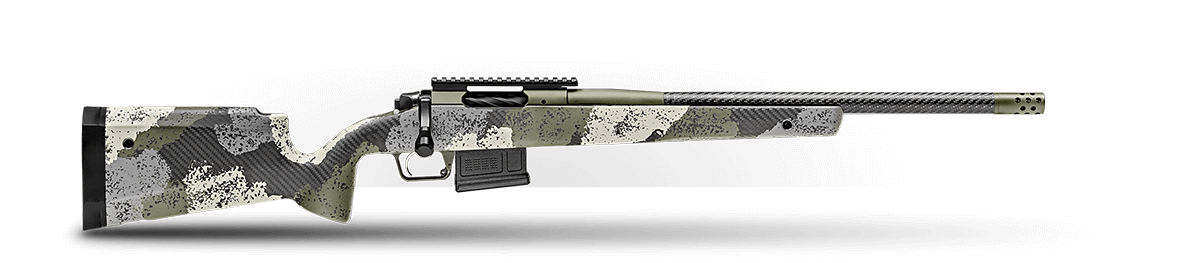
An internet search turned up few rifles in 6mm CM. But not long thereafter, I found the cartridge offered in Springfield Armory’s Model 2020 Waypoint, a well-designed, beautifully built carbon fiber-barreled rifle that in 6.5 CM had impressed me with its smooth function and dime-size groups.
Ballistic Comparisons
.240 Weatherby Magnum, 100-grain Nosler Partition
6mm Creedmoor, 103-grain Hornady ELD-X
6mm ARC, 103-grain Hornady ELD-X
6.5 Creedmoor, 120-grain Hornady GMX Superformance
A New Home
The Waypoint’s Remington 700 footprint makes it a natural for swapping components, but I had no such plans for this 6mm CM. The hand-laid AG Composites carbon fiber stock weighs less than two pounds and is pillar bedded. Fluted deep behind the vertical grip, with M-Lok slots up front and five QD swivel pockets, it’s comfy in any shooting position, with or without sling or bipod.
A fluted, twin-lug bolt with dual cocking cams glides in EDM-cut races. The stainless receiver and nitrided bolt are machined after heat-treating so finished dimensions match spec. The beefy 6mm-wide extractor is angled for easy push-feed lock-up. The TriggerTech trigger adjusts to 2½ pounds, and has a “free-floating roller” for slick release. Lock time is a blindingly quick 1.9-milliseconds.

Unlike the 700, the Waypoint’s recoil lug is integral with the receiver ring. Four 6-48 screws and two recoil pins secure a Picatinny rail with 20 m.o.a. of gain for long shooting. Receiver, bottom metal, barrel shank and muzzle brake are Cerakoted. A detachable AICS-pattern, single-stack magazine feeds to centerline. Choose a button-rifled BSF carbon fiber barrel or a fluted stainless. Twist rate: 1:7.5. A brake is included with either barrel, on 5/8-24 threads.
Springfield’s .75 m.o.a. accuracy guarantee showed up as I shot “around the square” at 100 yards to check dials on the Blackhound 2-12×44 scope. After 96 clicks in all directions, my last bullets punched a knot half an inch off the initial group. Berger, Federal and Hornady loads, with bullets of 95, 103, 105 and 109 grains held to Springfield’s standard.
Now fitted with a 2.5-10×45 Leupold, this 6mm CM weighs 8 pounds. The rifle is proportioned for long-range prone shooting, but light enough for a “walking day” afield. Feeding is slick and faultless. Ditto the 3¼-pound trigger pull. Extraction and ejection are snappy.

The 6mm CM matches the .243 Win. and 6mm Rem. as a hunting cartridge, while its shape better accommodates bullets for long-range shooting. Ballistically, it outpaces the new 6mm ARC (Advanced Rifle Cartridge), introduced by Hornady for AR-15s. Ringing steel plates out yonder or filling deer tags, the 6mm CM has no liabilities. In a rifle like Springfield’s Model 2020 Waypoint, it’s getting long looks from brethren who might once have thought 6mms yesterday’s news.
While the 6mm’s were big news 70 years ago, they gave way to bigger, faster, needlessly violent rounds. It looks like it’s time for a re-think.
Editor’s Note: Be sure to check out The Armory Life Forum, where you can comment about our daily articles, as well as just talk guns and gear. Click the “Go To Forum Thread” link below to jump in!
Join the Discussion
Featured in this article
Read the full article here