
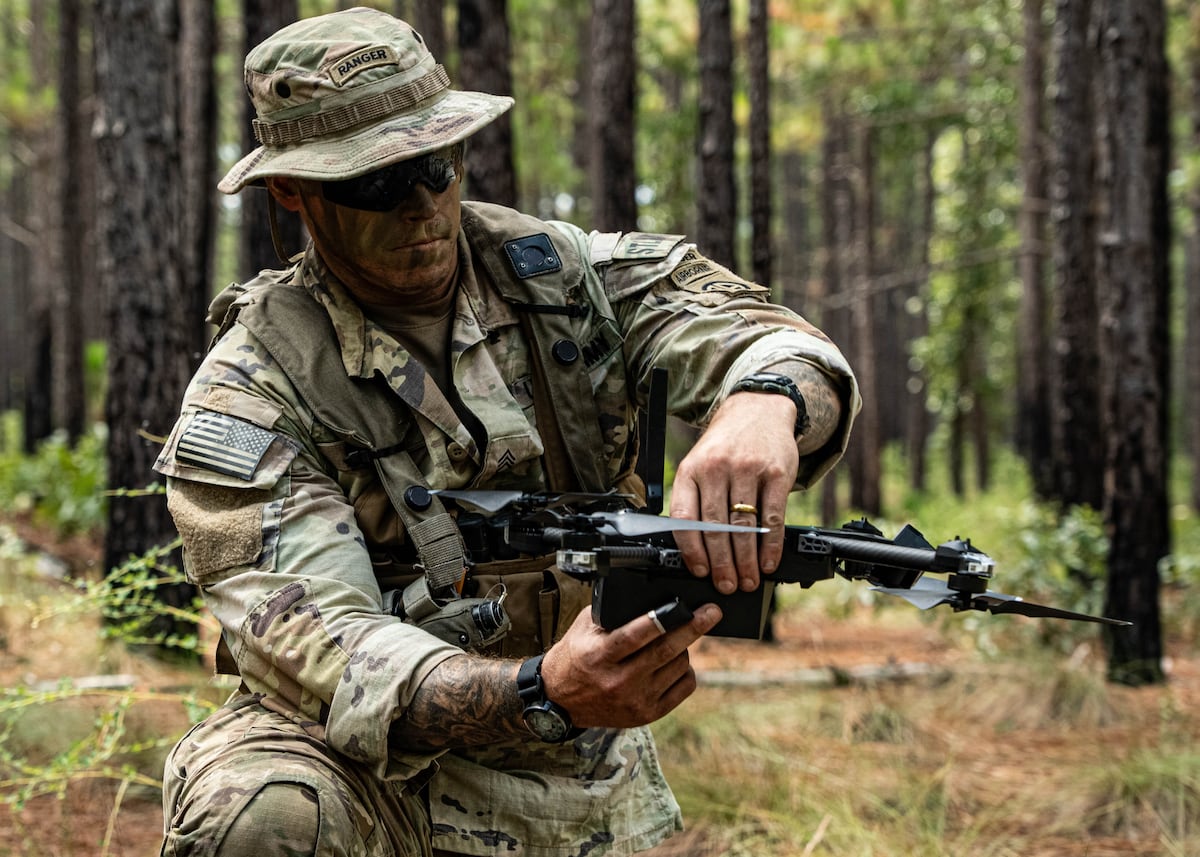

On Tuesday, the Pentagon released an open call to industry to rapidly obtain and deploy over 300,000 small one-way-attack drones — with the Pentagon hoping to put them into the field at such a pace that operators can learn to use them within two hours.
The $1 billion initiative aims to have the one-way attack drones in the hands of service members by 2028.
The RFI document calls for small drones capable of carrying a minimum of 4.4lbs in explosives and able to conduct strikes across both open terrain and urban environments. The drones are expected to prove they can maneuver across roughly six miles of open land and conduct a strike across over half a mile within a city environment.
“We cannot afford to shoot down cheap drones with 2 million dollar missiles and we ourselves must be able to field large quantities of capable attack drones,” Defense Secretary Pete Hegseth said in a video announcement released on social media.
“We will deliver tens of thousands of small drones to our force in 2026 and hundreds of thousands of them by 2027,” Hegseth said, adding that the new technology will see changes to combat doctrine across all U.S. military branches.
Although the documents do not specify an exact model that the drones might follow in terms of their assembly, the description is consistent with what corresponds to first person view drones, which are commonly built as quadcopters.
The competitive process, called gauntlets, will occur in four phases from February to July of next year and call for drone demonstrations.
The initial phase will see 12 companies produce 30,000 drones, while the following successive phases will see the number of drones increase while price per unit and number of vendors will decrease. Companies not selected by the Pentagon initially are still encouraged to compete, according to the RFI.
The RFI follows a series of steps taken by the Pentagon to acquire and put drones into action in the wake of an Executive Order from President Donald Trump on June 6 calling for the expansion of the U.S. drone industrial base and for the increased adoption of drones across federal agencies. This order was followed by a July 10, 2025, memo released by Hegseth announcing measures to swiftly purchase and integrate drones across all U.S. military branches.
Measures taken to implement the use of small drones in field units have taken on diverse forms over the last several months. In September, U.S. Central Command formed a task force to speed up the delivery and repair of drones to battlefield units. Last month, U.S. Army Northern Command formed a rapid response team to counter drone threats to U.S. military installations nationwide using a fly-away kit produced by Anduril.
Additionally, U.S. Special Operations Command has called for a 10-day in-depth training course for special warfare operators to teach them all aspects of both building and wielding first person view drones.
Zita Ballinger Fletcher previously served as editor of Military History Quarterly and Vietnam magazines and as the historian of the U.S. Drug Enforcement Administration. She holds an M.A. with distinction in military history.
Read the full article here