

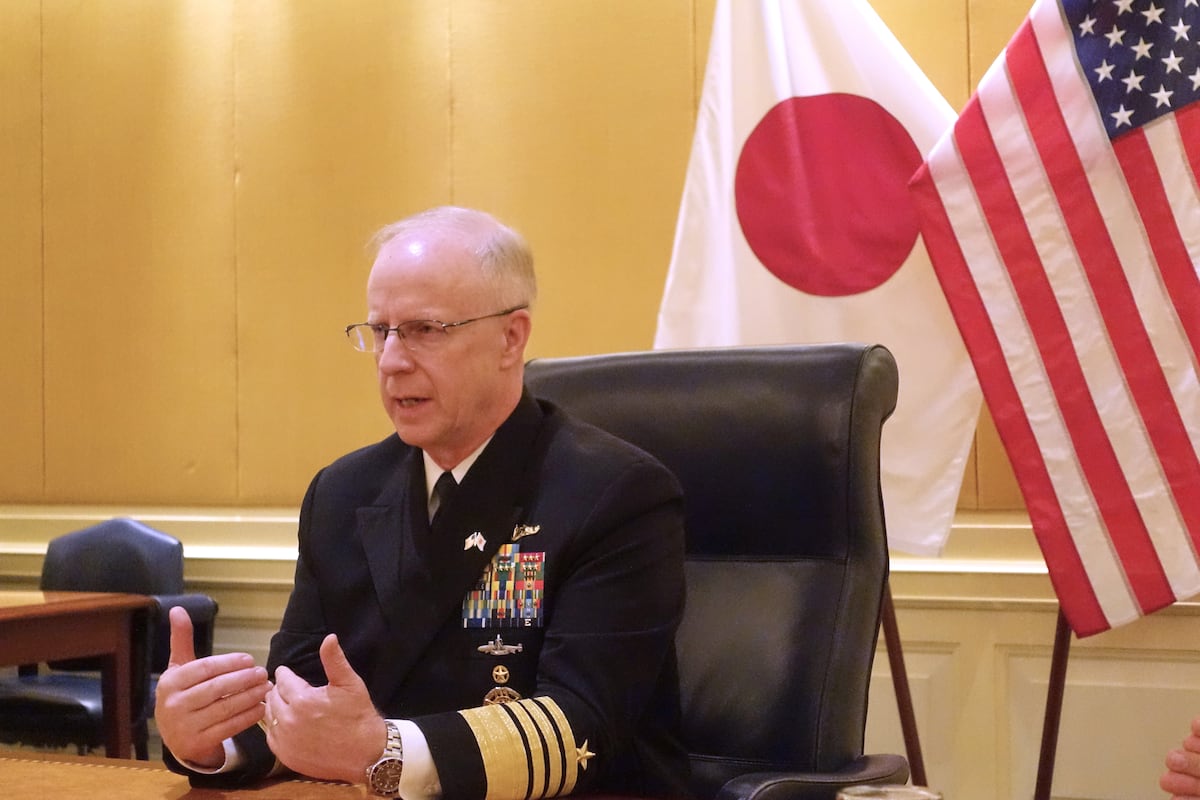

The U.S. Navy’s top uniformed officer wants to convince commanders to use smaller, newer assets for missions instead of consistently turning to huge aircraft carriers — as seen now in the American military buildups off Venezuela and Iran.
Adm. Daryl Caudle’s vision — what he calls his “Fighting Instructions” — calls for the Navy to deploy more tailored groups of ships and equipment that would offer the sea service more flexibility to respond to crises as they develop.
The new strategy comes as the Trump administration has moved aircraft carriers and other ships to regions around the world as concerns have cropped up, often disrupting standing deployment plans, scrambling ships to sail thousands of miles and putting increasing strain on vessels and equipment that are already facing mounting maintenance issues.
The world’s largest aircraft carrier, the USS Gerald R. Ford, was redirected late last year from the Mediterranean Sea to the Caribbean Sea, where the crew ultimately supported last month’s operation to capture then-Venezuelan President Nicolás Maduro. And two weeks ago, the USS Abraham Lincoln arrived in the Middle East as tensions with Iran rise, having been pulled from the South China Sea.
In a recent interview with The Associated Press before the document’s rollout, Caudle said his strategy would make the Navy’s presence in regions like the Caribbean much leaner and better tailored to meet actual threats.
Caudle said he’s already spoken with the commander of U.S. Southern Command, which encompasses the Caribbean and Venezuela, “and we’re in negotiation on what his problem set is — I want to be able to convey that I can meet that with a tailored package there.”
Admiral sees a smaller contingent in the Caribbean in the future
Speaking broadly, Caudle said he envisions the mission in the Caribbean focusing more on interdictions and keeping an eye on merchant shipping.
The U.S. military has already seized multiple suspicious and falsely flagged tankers connected with Venezuela that were part of a global shadow fleet of merchant vessels that help governments evade sanctions.
“That doesn’t really require a carrier strike group to do that,” Caudle said, adding that he believes the mission could be done with some smaller littoral combat ships, Navy helicopters and close coordination with the Coast Guard.
The Navy has had 11 ships, including the Ford and several amphibious assault ships with thousands of Marines, in South American waters for months. It is a major shift for a region that has historically seen deployments of one or two smaller Navy ships.
“I don’t want a lot of destroyers there driving around just to actually operate the radar to get awareness on motor vessels and other tankers coming out of port,” Caudle said. “It’s really not a well-suited match for that mission.”
Turning to drones or robotic systems
To compensate, Caudle envisions leaning more heavily on drones or other robotic systems to offer military commanders the same capabilities but with less investment from Navy ships. He acknowledges this will not be an easy sell.
Caudle said even if a commander knows about a new capability, the staff “may not know how to ask for that, integrate it, and know how to employ it in an effective way to bring this new niche capability to bear.”
“That requires a bit of an education campaign here,” he later added.
President Donald Trump has favored large and bold responses from the Navy and has leaned heavily toward displays of firepower.
Trump has referred to aircraft carriers and their accompanying destroyers as armadas and flotillas. He also revived the historic battleship title for a planned type of ship that would sport hypersonic missiles, nuclear cruise missiles, rail guns and high-powered lasers.
If built, the proposed “Trump-class battleship” would be longer and larger than the World War II-era Iowa-class battleships, though the Navy has not only struggled to field some of the technologies that Trump says will be aboard but it has had challenges building even smaller, less sophisticated ships on time and on budget.
Given this trend, Caudle said if the Lincoln’s recent redeployment to the Middle East were to happen under his new plan, he would talk with the Indo-Pacific commander about how to compensate for the loss.
“So, as Abraham Lincoln comes out, I’ve got a three ship (group) that’s going to compensate for that,” Caudle suggested as an example.
Caudle argues that his vision already is in place and working in Europe and North America “for the last four or five years.”
He said this could apply soon in the Bering Strait, which separates Russia and Alaska, noting that “the importance of the Arctic continues to get more and more prevalent” as China, Russia and the U.S. prioritize the region.
Trump has cited the threat from China and Russia in his demands to take over Greenland, the Arctic island overseen by NATO ally Denmark.
Caudle said he knows he needs to offer the commanders in that region “more solutions” and his “tailored force packages would be a way to get after that.”
Read the full article here