

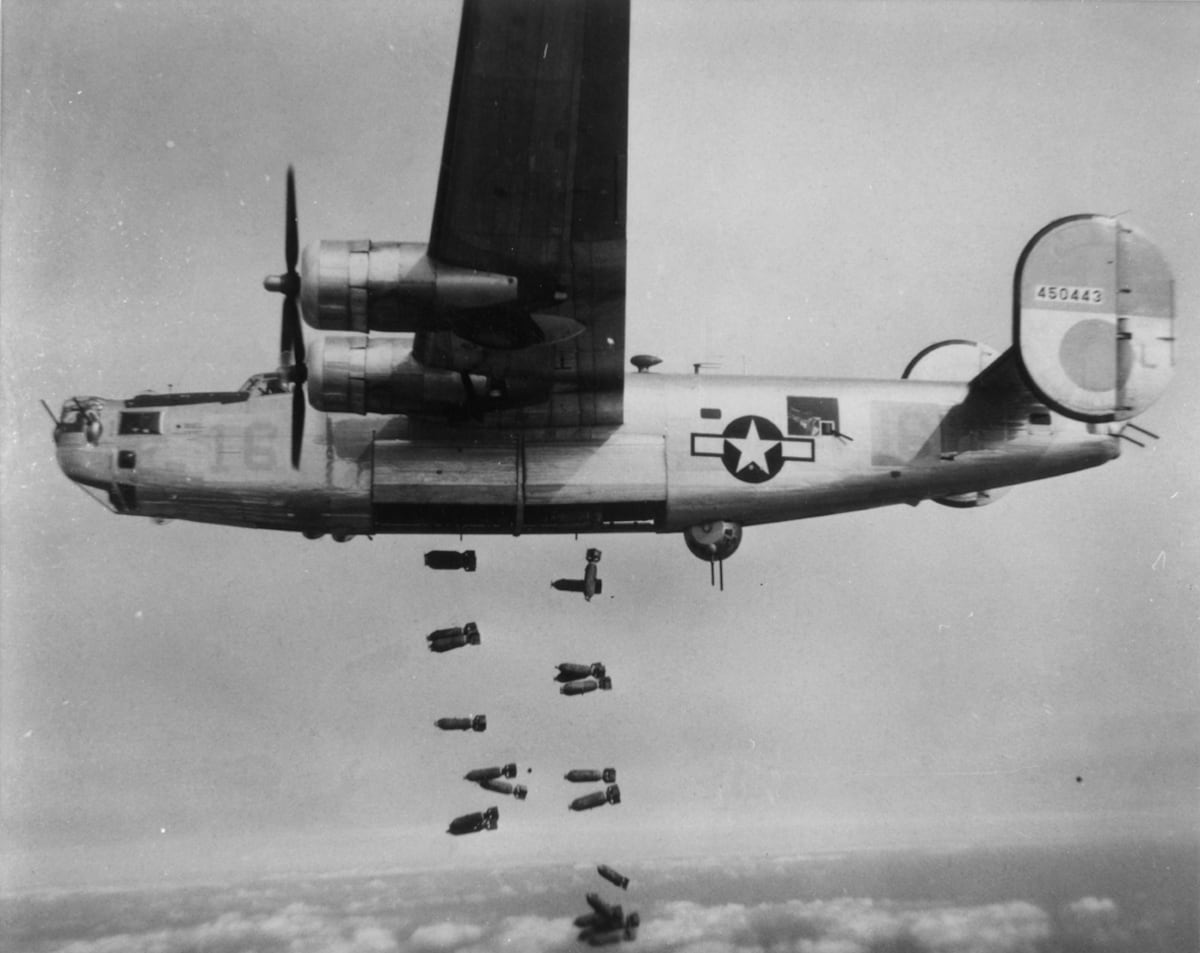

The day began ominously.
It was Friday the 13th when the airmen of the 451st Bomb Group of the 15th Air Force based in Castelluccio, Italy, gathered in an ancient wine cellar which housed Group Operations.
“Gentlemen, our target today will be … Vienna,” Ed Ryan later recalled in Veteran Voices Magazine. Audible groans could be heard throughout the cellar. Experienced crewman knew how well defended the Austrian city was, laced with anti-aircraft guns.
Ryan, who served as a navigator, knew too, as he had flown 12 missions prior to that October day. It would be his 13th bombing run — set on the 13th.
“Friday, October 13, 1944: Friday the 13th. My lucky day,” Ryan wrote. “For the rest of my life, I would celebrate Friday the 13th whenever it appeared on the calendar. It was the day I should have died, but didn’t.”
It was overcast as Ryan’s B-24 took off, positioned in at the rear of the squadron. The men morbidly called it the “Purple Heart” position, as it left whoever was flying in that spot the most vulnerable to flak.
“I can’t say I was scared,” said Ryan. “I understood intellectually the odds of being shot down. But I never in my gut doubted that I would return from a mission. If it was going to happen, it would happen to another guy, not me. I was nineteen years old, too young to feel vulnerable.”
The target that day was a factory located in Floridsdorf, on the northern shore of the Danube, across from Vienna. As the B-24 approached its initial point, the crew’s top turret gunner, Dave Johnson, made a request.
He asked to come up to the nose to see the bombs drop. According to Ryan, Johnson had made that request on every mission — 12 times so far — and the crew “hated him for it.”
“Come on, guys, just let me come up, and I’ll return to the turret when we pull away from the target,” Ryan recalled the crew chief pleading.
“Our bombardier had finally had it,” Ryan recounted. “He turned and looked at me and chimed in on the interphone. ‘Oh, for Christ’s sake, let’s let him down here this one time, and that’ll be the end of it. He’ll see the drop, and that’ll be it. If he asks again, we’ll beat the hell out of him. You hear that, Dave?’”
Ryan, “snarl[ing] inwardly,” packed up his briefcase of charts and maps, unsnapped his parachute and squeezed past the “real jackass” Johnson.
“I was only nineteen, the youngest crew member by two years,” wrote Ryan. “If I had been older, I probably wouldn’t have allowed it, and I would have died that day.”
The last-minute swap saved Ryan’s life.
Less than 30 seconds after dropping its payload, the B-24 and its crew were hit simultaneously by three German 88s. The flak sheared off the entire nose of the plane and instantly killed the bombardier, the nose gunner and the crew chief.
With the bomb bay doors open, the pilot ordered Ryan to bail. The co-pilot had already dived headfirst out the door and the captain was urging the navigator to do the same.
The plane began to tilt wildly to and fro, and it was only then that Ryan noticed that the left side of his body was on fire. The plane lurched again and miraculously, Ryan’s unstrapped parachute flew towards him. Catching it, he slung it across the only side of his body not engulfed in flames and jumped.
Slamming his head against the catwalk that spanned the open bomb bay door, Ryan was knocked out cold. When he came to, he was in a free fall at 20,000 feet. Nonchalantly patting out the flames on his face and flight suit, Ryan began to see figures running beneath him. Bullets began to whiz by him and he terrifyingly realized he was “falling into the heart of the city I had just bombed.”
Ryan landed hard on city pavement and once again lost consciousness. When he came to, he recalled civilians were beating him with garden tools — “a shovel came down on my arm, I remember that,” he wrote.
The petrified American recalled that it was like looking through gauze, everything was hazy, tinged with red.
Shots rang out and German soldiers pushed through the crowd and hauled Ryan into the back of a truck where he once again lost consciousness.
When he awoke, he was in Luftwaffe Hospital 4/XVII.
“The left side of my face was badly burned, as was my hand, which was hardly recognizable,” Ryan wrote. “Where my flight suit covered skin, I was fine. Only the exposed parts were damaged. My left hand was bent grotesquely backward, the fingers curled so that the fingertips almost touched my forearm. I languished in what seemed like a hallway. After a few days, my burns became infected, and my hand began to putrefy.”
But Ryan’s luck was soon about to turn, as the smell of his putrefying flesh caught the attention of Dr. Josef Zikowski, head of the Robert Koch IV-A Infectious Disease Hospital in Vienna — which also housed deadly Nazi medical experiments.
Upon learning that Ryan was scheduled to have his left hand amputated the following morning, Zikowski arranged for Ryan’s transfer to the Koch Institute.
For the next three days, Zikowski, aided by two assistants “cut, scraped, and cleaned [Ryan’s] wounds for three days without cease. … They sprayed a solution on to the burned skin tissue every five minutes for three days. I don’t know what was in the solution, but the treatment worked, and I began to heal,” Ryan wrote.
Surrounded by six other American airmen, Ryan soon discovered that none of them were sick — save for the nausea caused by the odor of his wounds, he quipped.
Zikowski and the nuns who worked beside him had struck a deal with the POWs. As the Allies continued to advance across Europe, particularly as the Soviets continued to inch closer to Vienna, the doctor struck a Faustian deal with the Americans.
Zikowski would falsify their records to prevent them from being shipped to POW camps and in return he wanted the Americans to vouch for him and his staff for when the Red Army inevitably marched into the city.
For the next five months Ryan and his fellow POWs subsisted on half-rations and what they managed to steal until one day in March 1945 the German guards simply disappeared.
The Soviets had arrived in the city.
Greeted with bear hugs and vodka, life under Red Army rule, however, was worse for Ryan than under the Germans.
“I saw drunken Russian soldiers shoot up whole rooms full of patients, regardless of sex or nationality. One April morning, while I was walking through a breezeway between buildings, bullets whizzed past my head, and I turned to see a Soviet soldier sitting outside on the lawn laughingly taking pot shots at me. He was drunk, and I sprawled to the floor to keep from getting hit.”
It was then that the Americans took fate into their own hands and simply walked out of the hospital, bound for Budapest, Hungary.
From there, Ryan and 30 other Americans were loaded into a C-47 en route to Foggia, Italy. It wasn’t until the plane was taxiing that Ryan allowed himself to believe that he was going to live.
Turning to fellow POW Claude Porter, Ryan sought to return to the United States by water.
“Flying is too dangerous,” he concluded.
Claire Barrett is an editor and military history correspondent for Military Times. She is also a World War II researcher with an unparalleled affinity for Sir Winston Churchill and Michigan football.
Read the full article here