

“The world is not supposed to know what the hell they did with me. I’m not supposed to be commanding this army. I’m not even supposed to be in England. Let the first bastards to find out be the goddamned Germans,” came the roar of actor George C. Scott in his famous delivery of George S. Patton’s speech to the Third Army.
“Some day, I want them to rise up on their piss-soaked hind legs and howl ‘Ach! It’s the goddamned Third Army and that son-of-a-bitch Patton again!’”
For many laypeople, that 1970 oratory spectacle that was their first — and perhaps only — introduction to Patton. And it stuck.
Scott’s portrayal of Patton has become almost interchangeable with the veritable World War II general.
The National WWII Museum in New Orleans, however, in a two-day symposium taking place on March 13-14, is exploring more than just the “blood and guts” of Patton, but an in-depth exploration of one of the war’s most iconic — and controversial — commanders.
“I think that the reality of Patton and the image that a lot of people have of Patton diverges pretty greatly,” Bradley C. Hart, the World War II military historian at the Jenny Craig Institute for the Study of War and Democracy, told Military Times.
“When we started planning for the symposium, I went back and did a bunch of reading on Patton and realized that — I don’t have any polling to support this — but I think if I put a picture of George C. Scott in front of people they would think that that’s actually a picture of Patton. I think that 1970 film shapes the way the vast majority of Americans view this man today.”
History and memory are fickle things, and something the museum hopes to tackle during its two-day symposium. In the case of Patton, his early death in December 1945, for better or for worse, helped to shape his legacy.
“There’s a lot of movies about Eisenhower,” Hart noted. But “there’s no movie called Ike, right? I think Patton uniquely lends himself to that sort of discussion of history memory.”
“I think the part I’m most excited about, actually, is sort of digging into that specific nexus between history and memory,” Hart adds. “How is our memory of Patton related to the reality of Patton as individual?”
Gen. Raymond E. Mason’s upcoming lecture, “Patton in Myths, Movies, and Monuments,” as well as the museum’s featured conversation, “Patton’s Shadow: The Making of a Hero in Modern Memory,” will address “the mythology and also try to unravel the real story,” says Hart.
Yet, despite this unraveling, according to Hart, “this is a man who, from my research, gets more interesting the more you dig into.”
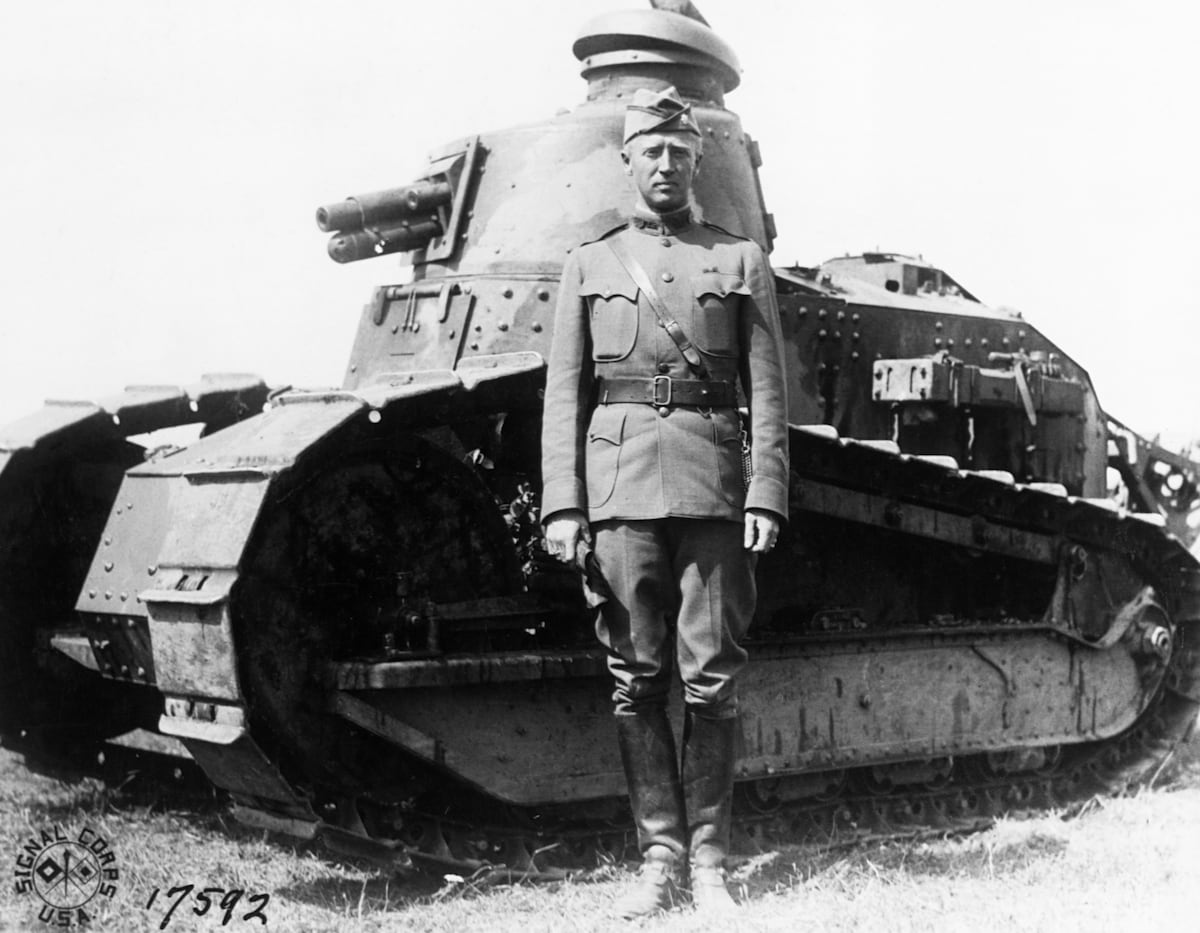
The Patton of today commands attention as a near-mythic figure: He cultivated this swagger, this larger-than-life persona; earned the admiration of the GIs who served under him; and died relatively young after winning one of the greatest victories of the war, the Battle of the Bulge, and holding key command of the “Ghost Army” in the lead up to D-Day.
He was rightly lauded in the postwar years by his peers, and famously, by his former adversaries.
Adolf Hitler called him the American cowboy.
German general Günther Blumentritt, a key planner of the invasions of France and Poland, wrote in a study for the U.S. Army after the war, “We regarded General Patton extremely highly as the most aggressive Panzer General of the Allies, a man of incredible initiative and lightning-like action … His operations impressed us enormously, probably because he came closest to our own concept of the classical military commander.”
Alfred Jodl, who served as Hitler’s chief of operations from 1940 until the end of the war, told American interrogators, “He was the American [Gen. Heinz] Guderian. He was very bold and preferred large movements. He took big risks and won big successes.”
Guderian himself, after Germany’s surrender, told his Allied captors, “From the standpoint of a tank specialist, I must congratulate him for his victory since he acted as I should have done had I been in his place.”
Patton emerged from the war as one of the most recognizable — and written about — American figures of World War II. A fact, perhaps, that the general would have loved.
But he was also a man who wrote poetry. He frequently wrote touching letters to his wife, Beatrice, such as, “I am not so hellish young and it is not spring, yet still I love you just as much as if we were 22 again on the baseball grandstand at West Point the night I graduated.”
In another letter, after a gasoline lantern exploded and badly burned his face, Patton wrote, “I love you with all my heart and would have hated worst to have been blinded because I could not have seen you.”
He also was at the forefront of mechanized warfare from the early aughts of the 20th century.
“Obviously, we know how [Gen. Douglas] MacArthur’s story turns out because of what happens in the Korea period,” says Hart. “I think part of the fascination with Patton is we don’t know how that story might have turned out, right?”
Featured speakers for the National WWII Museum symposium include leading scholars and historians, such as Rick Atkinson, Kevin M. Hymel, Nathan C. Jones, Rob Citino, Nicholas Evan Sarantakes, Greg Fontenot, John Nelson Rickard and Roland Gaul, among others.
“Even if you’ve read a lot about Patton, there’s seemingly always something else to learn,” says Hart. “This is a man who’s whose life is complicated. He had a long career. He’s more influential in the shaping of the contemporary military doctrine, especially armored doctrine, than a lot of people appreciate. So I think that’s where a lot of even our best-read, best-informed guests, are going to going to find out something new.”
The two-day symposium will be live-streamed on the museum’s YouTube channel for those hoping to tune in remotely.
Claire Barrett is an editor and military history correspondent for Military Times. She is also a World War II researcher with an unparalleled affinity for Sir Winston Churchill and Michigan football.
Read the full article here