
After the American victory over the British on Jan. 3, 1777, Gen. George Washington managed to hang on to his army — but just barely.
As both British and American armies settled into their winter quarters both were back to almost the same positions held in mid-November.
Except for a small garrison at Paulus Hook across the Hudson from lower Manhattan, all of New Jersey had been abandoned by the British, according to Pulitzer Prize-winning journalist and historian Rick Atkinson.
The withdrawal left thousands of New Jersey loyalists to fend for themselves against the agitated rebels, with one loyalist writing of “mortification and resentment” at being left by the British.
The retreat had “made our brave fellows almost gnaw their own flesh out of rage,” the loyalist added.
The forfeiture of the New Jersey granary, according to Atkinson, further stressed British logistics. All supplies, seemingly, would have to come via 3,000 miles of open ocean.
“The Treasury Board calculated that feeding 40,000 soldiers for the next year would take 7,300 tons of flour and 4,500 tons of salt meat, among other foodstuffs,” writes Atkinson. “Also, 4,000 army horses would consume 20,000 tons of hay and oats annually; Howe was told that 15,000 tons could be purchased in Rhode Island, but to date he had received barely a hundred.”
So began the frantic search for forage, devolving into a little-known partisan campaign between the Patriots and British as both sides competed for scarce resources.
These skirmishes and small engagements continued throughout the winter of 1776-1777, with Washington issuing orders that his men were to be “constantly harassing the enemy.”
One such clash occurred in Spanktown, New Jersey, (present-day Rahway). Named thusly after an early settler publicly took his spouse across his knee and chastised her in the town center, Spanktown was to play an important role in the later dubbed Forage Wars.
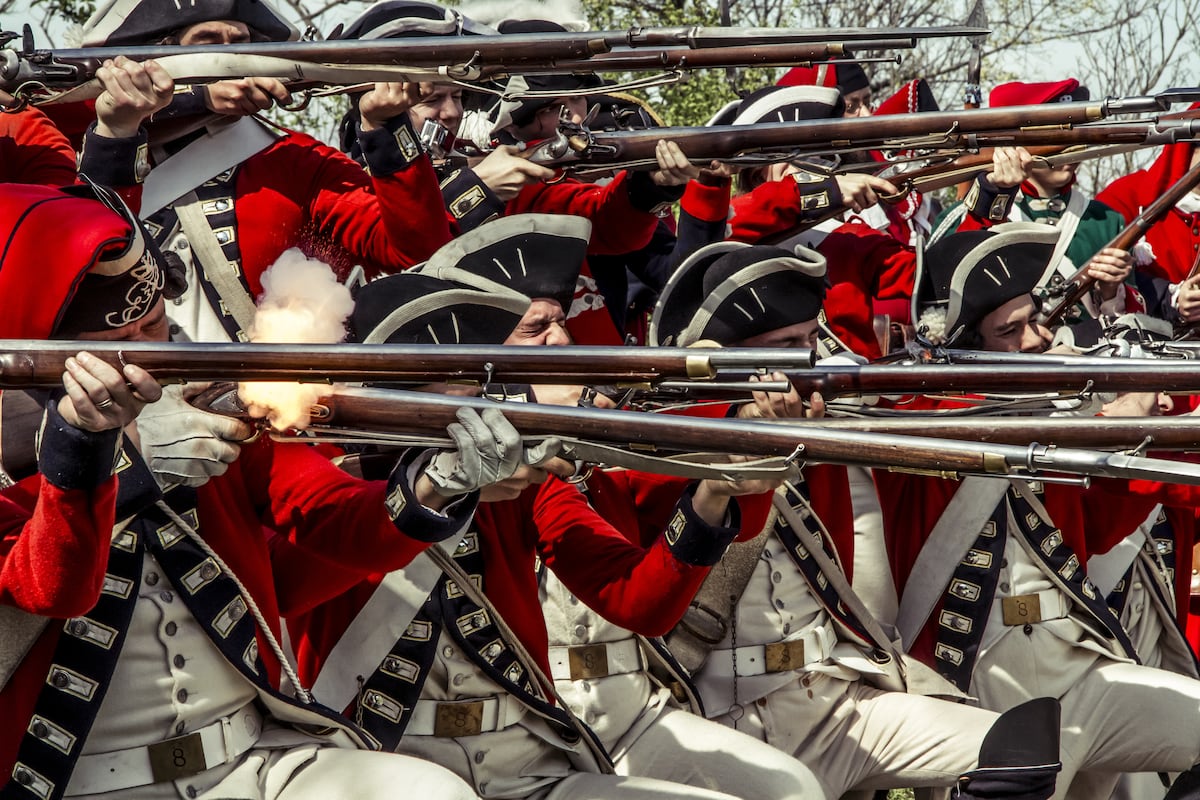
On Feb. 23, 1777, British Lt. Col. Charles Mawhood sent out a battalion each of light infantry and grenadiers, plus the 3rd Brigade. Near Spanktown, Mawhood and his men found a group of militia herding some livestock and, thinking he had flanked a party of the New Jersey militia, attacked.
It was a trap.
Soon, Mawhood found his advance force flanked by Continental Army Brig. Gen. William Maxwell and his men who were lying in wait.
Superior knowledge of the geography had allowed Maxwell to set his trap and his larger force soon enveloped Mawhood and his grenadier company.
The initial ambush resulted in the loss of 26 British soldiers, but the Americans kept coming. For nearly 12 hours the British and Americans clashed until Mawhood ordered his men to fall back.
Mauled by the Patriots in their retreat, Mawhood later counted 69 killed and wounded and 6 missing in action. For their part, the Americans had lost five killed and nine wounded.
Just a few weeks later according to the Crossroads of the American Revolution, the badly spanked British decided to abandon New Brunswick and the surrounding areas, and would never again exert their control over the New Jersey countryside.
Claire Barrett is the Strategic Operations Editor for Sightline Media and a World War II researcher with an unparalleled affinity for Sir Winston Churchill and Michigan football.
Read the full article here