
As shooters, we have never had so much information on firearms, ammunition and the variety of training concepts available to us. We can attend a class taught by a world-class shooter one weekend and the next by an elite combat veteran of the U.S. military. Then there’s online video sources advocating nearly an endless array of training ideas, drills and methods. Let’s not forget standard shooting positions ranging from prone, kneeling and sitting in addition to standing. This doesn’t even touch upon the vital self-defense skills of drawing our holstered concealed handguns, getting in-time, on-time hits on targets, and then safely reholstering.
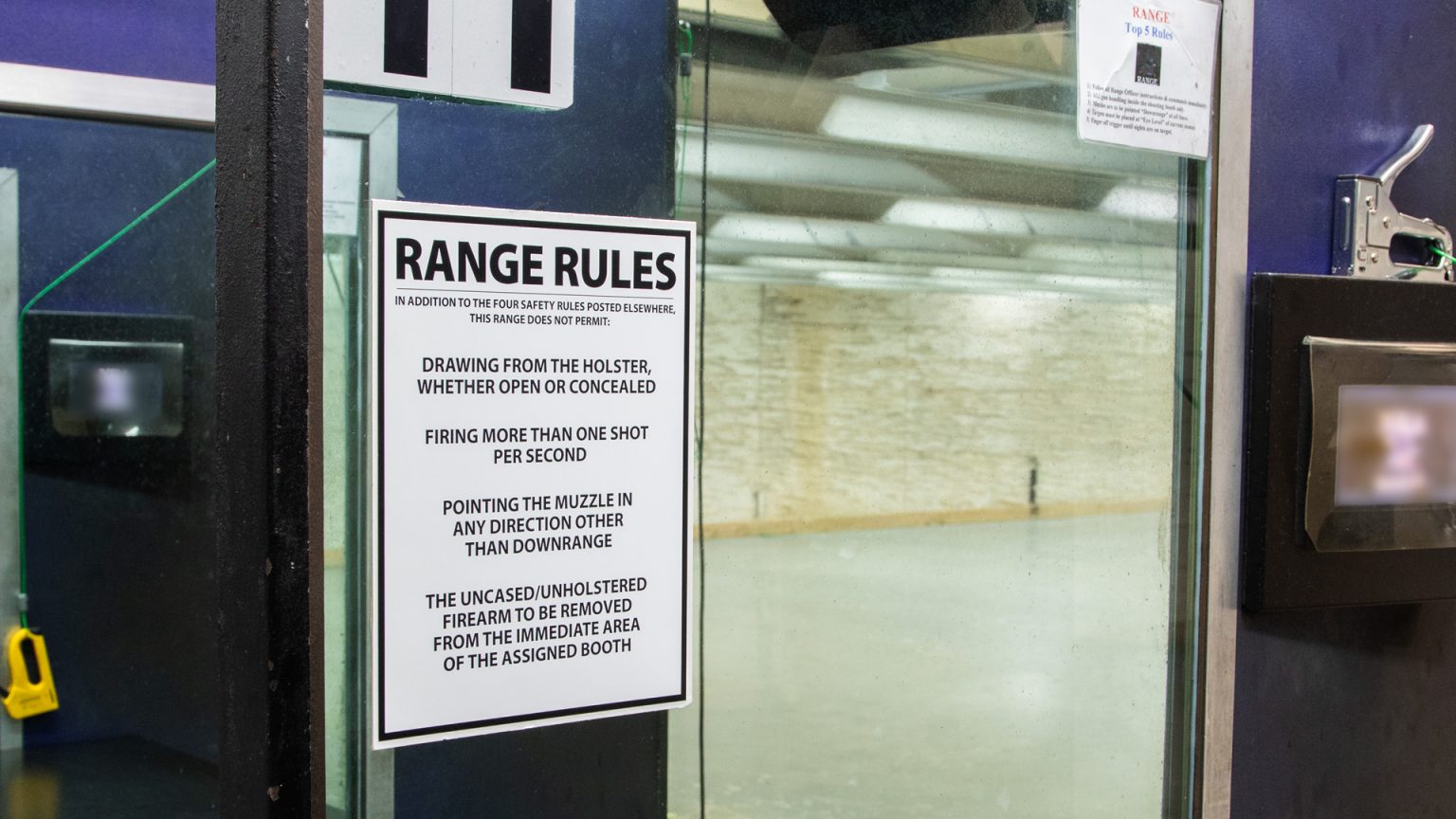
Often, public ranges frustratingly have extremely strict rules enforcing only the most basic firearm exercises: static, slow-fire target practice.
Now, let’s go to the range to practice (cue the sounds of thousands of brakes slamming on, tires screeching). Most of us are limited by our range facilities to picking our handguns off the bench to engage in slow-fire target practice. Often, public ranges frustratingly have extremely strict rules enforcing only the most basic firearm exercises: static, slow-fire target practice. Indoor ranges limit us to extremely small cubicles. Indoor and outdoor public ranges generally prohibit rapid-fire, often restricting shooters to no more than one shot per second.
Unfortunately, there is sound reasoning for these limitations. Many shooters are novices, having no formal training. These restrictions are necessarily based upon the need for maximum safety of everyone due to the varied levels of skill and safety among the shooting public.
You may have just graduated from a week-long, high-speed tactical course where you spent your time running and gunning, pushing the limits of your skills. You know these new proficiencies, like any skill, are extremely perishable, rapidly degrading without regular, conscious repetition. Or, you may hope to increase your skills beyond simple target shooting. If your range won’t permit practical live-fire self-defense training, what can you do?
The ability to draw while moving is a vital skill that requires practice. Move laterally (either right or left) by slide-stepping; don’t cross your feet. As you move, access your concealed pistol and begin your drawstroke and presentation—all the while looking at your adversary.
Professionals know that live-fire should be the lesser part of your training routine. While nothing can replace the need to fire bullets at targets, for much of our “tactical” or practical training, we can use other tools to ensure our skills stay robust.
Dry-fire
For professionals (and everyone else), dry-fire practice is essential for maintaining our skills. For every round fired at the range, it’s a good idea to dry-fire a minimum of five times. Dry-fire lets us concentrate solely on our firing procedure (grip, sight alignment/sight picture, focus on the front sight, trigger press and follow-through) without recoil. We can better observe our unforced glitches in our shooting processes. Smoothly practicing presentations of the handgun’s sights into the eye-target line (that imaginary line from your eyes to the target), seeing the sight picture and pressing the trigger creates what is casually known as “muscle memory” (muscles don’t have memory; it’s actually more properly described as “highly myelinated neural pathways” creating an efficient action after repeated and consistent repetitions).
Basics for dry-fire drills are conducted with absolutely no ammunition in or near the dry-fire area: 1) Designate a “no-ammo zone” and strictly adhere to this standard; 2) Dry-fire takes place only in the no-ammo zone; and 3) Before practice, guns are checked and then double-checked to ensure they are clear. Firearm-safety rules are strictly adhered to—especially muzzle direction—avoiding pointing the weapon at someone or something you are not willing to destroy; 4) Dry-fire practice sessions should each be limited to less than 10 minutes.
“But dry-fire is soooooo boring!” I’ve never understood that comment because there is soooooo much to pay attention to, learn from and work on. Frank Proctor uses the analogy of Information … Processing … Output for every shot. We take in the information of sight picture, process that information against the data we’ve already stored from every shot we’ve ever taken, then output a consistent grip for a consistent trigger press when conditions within the present shot are optimal to get the hit we need. We then note any aberrations in the shooting process (more information) to add to our database, then proceed to the next shooting process a little bit better than we were before.
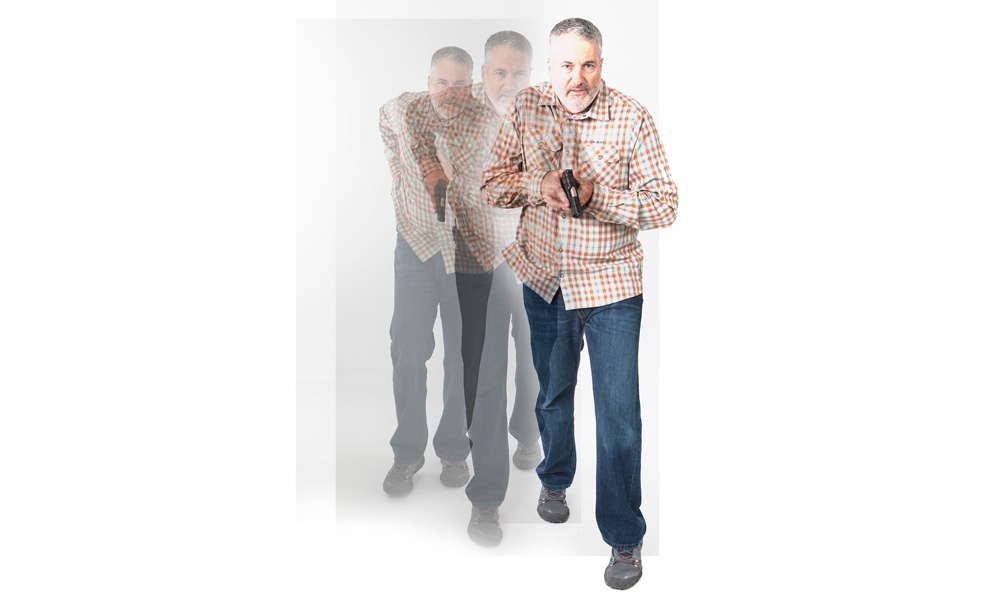
Defensive encounters are unpredictable. You may have to move forward to get to cover or better your sight line. Learn to draw when moving forward as well as backwards.
Every trigger press gives us information about everything we did during that individual process. Did the front sight move when the trigger was pressed? Probably an issue with the grip or excessive force on the trigger. Did the front sight move immediately prior to the shot breaking? Probably helping the shot break rather than simply facilitating the shooting process. Was my eye focused on that front sight both when the shot broke and afterward? If not, I need to concentrate on my attentional focus to maintain my follow-through. All of these points of consideration and more keep us interested and focused for those few minutes of dry-fire and directly apply to our live-fire practice.
Not Limited to Static Practice
Dry-fire practice is an opportunity to introduce more dynamic skills that cannot be attempted at most ranges. For example, in some self-defense situations, especially within several yards of a threat, moving while drawing your handgun creates surprise, introducing complexity for the attacker, presenting a moving target who’s fighting back. It’s also useful to draw when moving to cover, getting you into the fight more quickly.
With a cleared (or non-firing) handgun, present the handgun at the target and walk toward the target. You’ll probably see the sights bouncing off-target. Think of your legs as shock absorbers and allow them to calm your sights (no need to be dramatic with your posture). It takes only a little practice. Soon you begin to anticipate when your sights are moving on target, and a trigger press will gain your hit. This is the perfect time to mentally reinforce the concept of “acceptable area hits” rather than “small, perfect groups.” Once you gain familiarity, begin moving angularly forward and to the rear as well, noting how your shoulders and arms must modify their positions to maintain targeting.
Once you are more comfortable with moving and dry-fire, moving while drawing a concealed, unloaded handgun is the next step. As with everything, start slowly with the goal of being smooth while continuing to move throughout the drawing and firing sequence. Feet and hands move simultaneously, with hands clearing clothing for the gun-hand to establish a firm master grip, then executing the same draw stroke as you would in a stationary draw into the gun-target line. The trigger is pressed on the first acceptable sight picture. While practicing slowly at first to create perfect coordination, the speed of your movement and draw soon increases with increasing success.
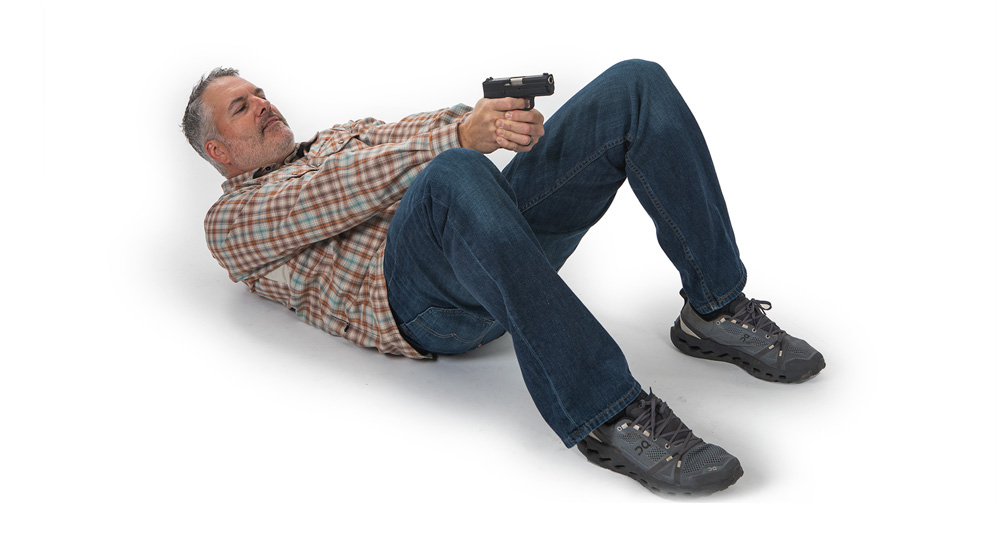
Among the necessary skills that can be practiced with dry-fire is deploying your gun from the ground or other awkward positions.
Other possible skills with which to familiarize yourself include working out how to draw or how to shoot from the ground in unusual positions should you trip, fall or be thrown to the ground And don’t neglect shooting when lying on your back or prone with your head toward the threat. Drawing your handgun while sitting in the car, safely negotiating the seat belt and steering wheel, may be useful given the amount of time we spend in our cars. Seated-draw practice in general may help prepare you should crises occur in venues like restaurants, theaters or even the office. You may find you need to rethink your style of carry. Learning to work inside your home around corners and from doorways can be explored. While not making anyone “combat ready” in house-clearing skills, this is about familiarization and not being forced to re-invent the wheel while under the pressure of imminent deadly threat.
There are also non-firing tools that can help us.
Laser Training Cartridges
There are some quality, yet relatively inexpensive, laser-training cartridges that will help determine our dry-fire accuracy. This turns our handguns into single-shot training tools, forcing the need to cycle the slide for each shot. This, for example, permits us to safely work on drawing: establishing our master grip, presentation, first round fired and holstering. Lasers provide instant feedback on the quality of every shot: A laser dot means a clean trigger press; a dash of the laser means a lapse in your grip or anticipation. We need to guard against changing eye focus to look for the laser dot. We’ll see it while still focused on the front sight.
SIRT Training Pistol
SIRT Training Pistols (which are available from Next Level Training) are a unique non-firing training aid providing a shot-indicating laser. It employs two lasers. The first is activated when the trigger is moved (staged). The second laser flashes, indicating where your sights were when you pressed the trigger, transmitting either the coveted laser dot or dreaded dash feedback. The resetting trigger is also adjustable, giving you the ability to customize your trigger press.
Because it is incapable of firing, the SIRT Training Pistol is ideal for many dry-fire applications. In addition to drawing and firing from the holster, moving while hitting, rolling and drawing on the floor or from a seated position, even training CQB or deadly force
in certain defensive-tactics situations with a friend, the SIRT Training Pistol safely permits all manner of practical dry-fire training.
Mantis X10 Elite
For those who want to take a deep dive into their shooting performance, the Mantis X10 Elite Shooting Performance System brings high tech to training. Attaching a seemingly weightless sensor to your handgun and wirelessly connecting to a smartphone, each trigger press provides more information than you may have hoped. Just some of the system’s feedback is muzzle trace (tracking how you presented and centered the muzzle to the target), shot placement, trigger control, a shot timer and more. It also generates the same information during live-fire. If we are striving to gain information from every shot to add to our personal database, this system provides hard data to compare against our perceived performance, data you can store and revisit as needed.
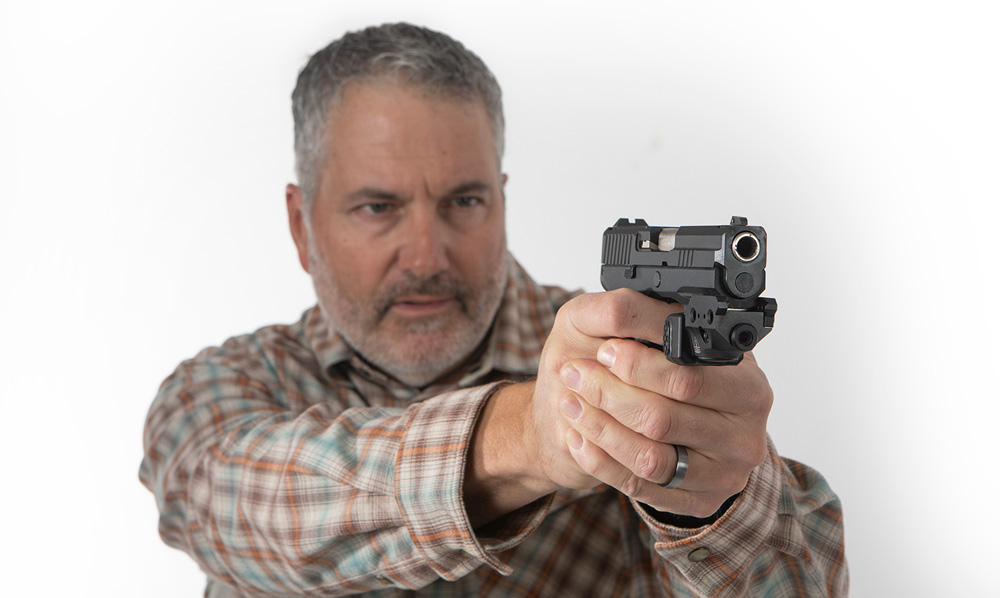
Mounted to your pistol’s accessory rail, the Mantis X10 provides a wealth of data to your smartphone during dry-fire or live practice.
There may be no firearm practice that cannot be safely performed in a dry-fire session, except recoil management. Our imagination is the only limit. While some are privileged to train at less-restrictive private ranges or on public land, most shooters must abide by strict range rules. We only allow ourselves to be restrained if we believe we are powerless to explore practical methods of self-defense shooting other than static-target practice.
Read the full article here